

The word “landline” doesn’t tell you whether a phone service will suit the way your team works. In 2026, a business landline may mean an internet-based voice service, so comparing business landline providers australia involves more than checking whether you can keep a fixed number. It’s understandable to be cautious: changing providers can raise concerns about number porting, equipment compatibility and missed customer calls.
Start with continuity, support and the call features your business actually needs. This guide explains the service options available to Australian businesses and shows you how to compare providers using practical criteria, from call management and support arrangements to planning a switch.
You’ll also learn what to confirm about your connection, existing phone equipment and number transfer before committing. Providers such as Business Telecom offer business landline connectivity and cloud phone options, giving businesses different ways to support office and remote teams. The aim is to help you choose a service that meets your current call needs and can adapt as your team grows.
Key Takeaways
- Separate voice connectivity from reception answering and phone hardware so you can compare like with like.
- Map how incoming calls should reach your team, then assess whether extensions, queues or an auto-attendant suit your workload.
- Compare business landline providers australia on essential features, support responsibilities, inclusions and contract terms before weighing optional extras.
- Before changing providers, confirm number transfer arrangements, equipment compatibility and how call continuity will be managed.
- Consider providers with landline, VoIP and cloud phone options so you can assess a setup that suits your team now and can adapt as it grows.
What business landline providers in Australia actually supply
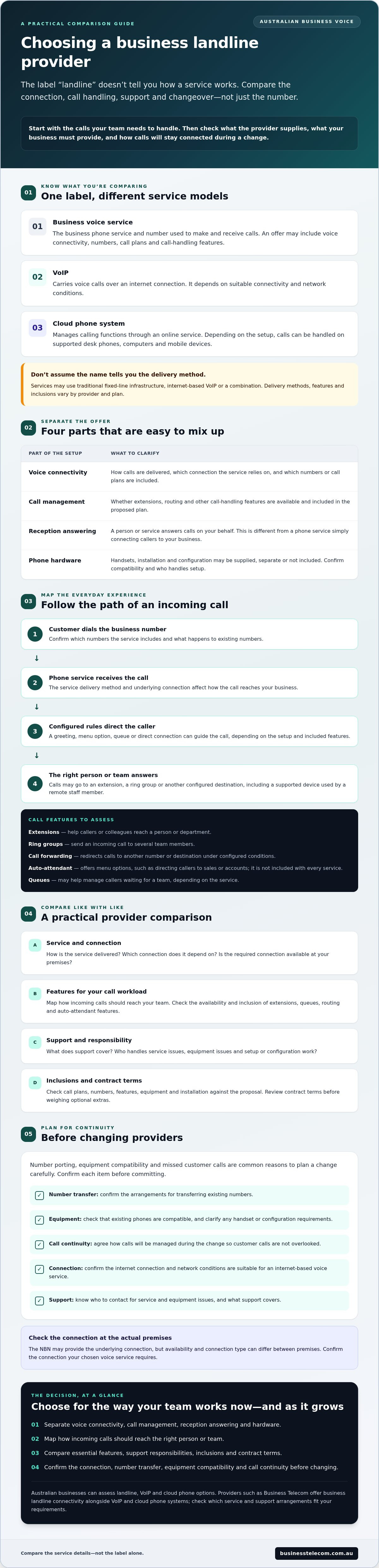
A business landline provider supplies fixed business voice connectivity and related calling services, such as call plans, numbers and call-handling features. The term can describe services delivered over traditional fixed-line infrastructure, internet-based VoIP, or a combination of options. Because the term is used in different ways, check how a provider delivers the service and exactly what its offer includes.
Provider choice in Australia reflects a telecommunications market shaped by changes in ownership and competition. The history of telecommunications in Australia provides useful background, but it won’t tell you what a particular provider includes today. Check the details in the service proposal.
Business landline, VoIP and cloud phone services
A business landline is the business voice service and number used to make and receive calls. VoIP carries voice calls over an internet connection, while a cloud phone system manages calling functions through an online service. These terms can overlap, but they don’t describe every provider’s offer in the same way. Delivery methods and features vary by provider and plan. If you’re assessing what happens as services move beyond copper, check the relevant guidance on business landlines transitioning beyond copper.
What a business provider may manage
Break the offer into separate parts before comparing providers. A proposal may cover voice connectivity, call charges or inclusions, and call-management settings such as extensions and routing. These components may be packaged together or listed separately. Reception answering is different: it means a person or service answers calls on your behalf, not simply that your phone service connects a caller to your business.
Phone hardware is another separate component. A provider may supply or configure handsets, but don’t assume equipment, installation or compatibility checks are included with connectivity. Ask what you need to provide and whether setup work is part of the proposal.
Before deciding, confirm:
- How the service is delivered and which connection it depends on.
- Which numbers, call plans and call-handling features are included.
- Whether handsets, installation and configuration are included or separate.
- What support covers and who handles service or equipment issues.
These distinctions make comparisons more useful than relying on the label alone. The phrase “business landline providers australia” can cover suppliers with quite different service models. Business Telecom offers business landline connectivity alongside VoIP and cloud phone systems. Its cloud options can support calls on desk phones, computers and mobile devices. Confirm which service, equipment and support arrangements match your team’s requirements.
How Australian business landline services support everyday calls
A business call typically follows a sequence: a customer dials the business number, the phone service receives the call, and routing directs it to the right person or team. Depending on the setup, the caller may hear a greeting, choose an option, wait in a queue or connect directly to a staff member. Mapping this call path helps you decide whether a service suits your reception, sales or support workload.
Call routing and staff access
Extensions let callers or colleagues reach a person or department without a separate public number for everyone. A ring group can send an incoming call to several team members, while call forwarding redirects it to another number or destination under configured conditions. An auto-attendant can offer menu options, such as directing callers to sales or accounts, but it isn’t included with every service. Confirm which features are available and whether they’re included in the proposed plan.
A cloud phone system can receive a call on a business number, apply configured rules such as an auto-attendant or queue, then ring a selected extension or team member on a supported desk phone, computer or mobile device. This can help staff handle calls across office and remote-work settings, provided the service and their devices support the required access. Check which devices staff can use, whether they can answer from different locations, and how transfers and missed calls are managed.
The internet connection and service resilience
Internet-based voice services rely on suitable connectivity and network conditions. The NBN may provide the underlying connection, but availability and connection type can differ between premises. Before choosing a service, confirm that the connection at each relevant workplace is suitable for expected call activity. Ask how voice calls may be affected if the connection becomes unstable or unavailable.
Plan for continuity rather than assuming calls will automatically move elsewhere during an outage. Ask the provider what backup options are available, how calls could be redirected if the main connection fails, and what your team would need to do. Clarify who to contact about a voice-service issue and who is responsible for investigating an internet connection problem.
The search phrase “business landline providers australia” can cover services with different call flows, device access and continuity arrangements. Compare these details with the way your team answers calls. Business Telecom offers business landline, VoIP and cloud phone options. You can review Business Telecom’s business phone options when considering which setup may suit your team.
How to compare business landline providers in Australia
Compare proposals against the same requirements, not just the service labels or feature lists. Start by separating essentials, such as the call capacity your team needs and how faults are handled, from optional features you may not use. A search for “business landline providers australia” should lead to a like-for-like assessment of service, support and terms.
Provider fit depends on your call needs, the support available and the connectivity your service relies on. Record what each proposal includes in a comparison table, then ask providers to confirm inclusions, exclusions and technical dependencies in writing.
| Compare | What to check |
|---|---|
| Service type | How voice service is delivered, what connection it depends on and whether it suits your sites and work arrangements. |
| Call features | Which numbers, extensions, call queues, forwarding or other call-management functions are included, and which cost extra. |
| Support | How to report a fault, how it is escalated and how your business receives updates. Confirm support hours and arrangements directly. |
| Inclusions | Whether devices, setup, configuration and any required compatibility checks are covered or remain your responsibility. |
| Contract terms | Term length, renewal conditions, fees or restrictions for service changes, and what happens if your requirements change. |
Questions to ask before choosing a provider
Ask who takes ownership when calls stop working, how faults move through the escalation process and how progress is communicated. Request a clear list of included call features and supported devices, rather than relying on a general service description. Check the contract for change conditions and clarify who supplies, configures and maintains any equipment. Written answers make differences between proposals easier to spot.
Matching provider capability to business size
A single-site team may need straightforward call distribution, but the right setup depends on call volume and staff availability. If calls need to reach several people, ask how shared call handling is configured and managed. As the team grows, check whether extensions and user settings can be adjusted without replacing the whole arrangement. For multiple sites, confirm whether call flows and settings can be managed consistently across locations, and whether each site’s connectivity and support requirements are covered.
Keep the comparison grounded in how your team works today, while checking that the arrangement can accommodate likely changes. A proposal is only comparable once you understand what it includes, what it depends on and who is responsible for each part.
Will changing business landline providers disrupt calls?
A provider change doesn’t have to mean an unplanned interruption, but continuity depends on preparation and clear coordination. Don’t assume number transfer, service activation and call routing will happen at the same time or without a change window. Ask both providers to confirm the arrangements for your service before agreeing to a date.
Keeping your business number and maintaining uninterrupted service are separate outcomes, so confirm each one independently. Number porting may be possible, but timing and requirements can vary by service. Get the proposed porting date, responsibilities and any expected impact on callers in writing.
Continuity questions to resolve before a change
Establish who coordinates the transition and which provider handles each task, including number porting, configuration and testing. Ask what callers may hear or experience during any agreed change window, and whether temporary call forwarding or another contingency is available. Don’t rely on forwarding as a fallback until the relevant provider confirms how it works, what it covers and whether it suits your setup.
- Who owns the transition plan and is the main contact?
- When will the number transfer and new service be tested?
- What should staff do if calls fail during or after the change?
Local support for Sydney, Brisbane and the Gold Coast
Support arrangements matter during a change, especially if your team needs help resolving a voice-service issue. Ask whether technical support is Australian-based, how your business contacts the team and how faults are escalated. If your business is in Sydney, Brisbane or the Gold Coast, confirm service availability for your specific location and ask whether on-site support is available. Don’t assume coverage or an on-site visit based on a provider’s general location list.
If you’re moving to VoIP, clarify number-porting requirements and timing with the providers involved. A separate guide to keeping a business number when switching to VoIP can help you prepare questions. Confirm the details for your service rather than relying on general timelines.
Before choosing among business landline providers australia, make continuity part of the comparison, not an afterthought. Business Telecom offers business landline, VoIP and cloud phone systems, along with Australian-based technical support. Confirm current availability and support arrangements for your location, then discuss your business phone requirements with the provider.
Choosing a business landline provider for your Australian business
A sound choice comes down to four practical checks: whether the service fits your team, how it handles calls, who owns support issues and how continuity will be managed if you change providers. Compare these points with your day-to-day requirements, not just a list of advertised features. The right option should work for your current setup and make sense if your staffing, locations or call volumes change.
Providers may offer business landline, VoIP and cloud phone services, but delivery methods, features and dependencies can differ. Ask for a clear explanation of what each option requires and who is responsible for connectivity, equipment and support. This gives you a stronger basis for comparing business landline providers australia and deciding whether one setup or another configuration suits your business.
When to speak with a provider
Start a discussion if your current service no longer matches your staffing or call-handling needs, such as when calls need to reach employees across different locations or teams. Prepare a short brief to keep the conversation focused:
- Your current business numbers and the locations that need service.
- The number of people who need to make or receive calls, including remote staff.
- Essential call features, such as extensions, call routing or shared call handling.
- Any equipment you want to keep, and questions about compatibility.
Ask the provider to explain what connection the service depends on, what is included, and who handles faults or transition tasks. Request confirmation of number-porting arrangements and timing before planning a change.
Discuss business phone options with Business Telecom
Business Telecom provides business landline connectivity, VoIP and cloud phone systems for business customers. Its cloud phone options can support calls across desk phones, computers and mobile devices, which may suit teams working in an office and remotely. The company states that it provides Australian-based technical support and lists Sydney, Brisbane and the Gold Coast as service locations. Confirm current availability and support arrangements for your specific location.
Use the details you’ve gathered to discuss which business phone option may suit your requirements. Discuss your business phone requirements with Business Telecom.
Choose a phone service that can grow with your team
The right provider is defined by more than the word “landline”. Compare how each service fits your call-handling needs, what support covers, and how the provider will plan for continuity if you change services. Confirm the details, including number-porting arrangements and technical dependencies, before committing.
Use these practical checks to assess business landline providers australia and choose a setup that suits your team today while allowing room for change. Business Telecom provides business landline, VoIP and cloud phone services, with Australian-based technical support. Sydney, Brisbane and the Gold Coast are listed service locations, but availability should be confirmed for your business.
If you’re ready to discuss your requirements, Discuss your business phone requirements. Prepare your call needs and key questions before getting in touch.
Frequently Asked Questions
What is a business landline provider?
A business landline provider supplies fixed business voice connectivity and related calling services. Depending on the provider, this may include a business number, call plan and features such as extensions or call routing. The service might use internet-based VoIP rather than a traditional copper connection. Phone hardware and reception answering are separate from voice connectivity, so check whether either is included or needs to be arranged separately.
Are business landlines still available in Australia?
Yes, businesses can still use fixed business voice services in Australia, although the term “landline” doesn’t necessarily mean a traditional copper line. New services may use VoIP or cloud phone systems delivered over an internet connection. Legacy service availability can depend on the premises and provider. Ask how a proposed service is delivered, what connection it relies on and whether it suits your location and equipment.
Can a business keep its phone number when changing providers?
Number porting may allow a business to keep its existing number when changing providers, but the process and timing depend on the service and must be confirmed. Ask both providers who coordinates the transfer, what information is required and when the number is expected to move. Confirm any planned change window and contingency arrangements too. Don’t assume that retaining the number means calls will be uninterrupted throughout the change.
What should I compare when choosing a business landline provider?
Compare service delivery, call features, support arrangements, inclusions and contract conditions. Check which extensions, queues or call-routing functions are provided, what devices staff can use, and who handles faults. Confirm connectivity dependencies, equipment responsibilities, service-change conditions and number-porting arrangements in writing. For searches such as “business landline providers australia”, focus on how well each proposal fits your call needs, team locations and continuity requirements rather than comparing feature lists alone.
How much does a business landline service cost in Australia?
Costs depend on the provider’s service model and the inclusions in your proposal, so there isn’t one price that applies to every business. Ask for a written breakdown of recurring charges, call charges, setup or equipment costs, and any fees that may apply if your service changes. Check whether the quoted amount includes the features and devices your team needs, and clarify any conditions before agreeing.
What happens to business calls if the internet goes down?
If your business voice service relies on the internet, calls may be affected when that connection fails or becomes unstable. The outcome depends on your configuration and any continuity options arranged with the provider. Ask whether calls can be redirected to another number or handled through an alternative connection, and what steps your team needs to take. Confirm how the backup works before relying on it during an outage.
Does Business Telecom provide business landline services in Sydney, Brisbane and the Gold Coast?
Business Telecom provides business landline, VoIP and cloud phone services, and lists Sydney, Brisbane and the Gold Coast as service locations. Availability should be confirmed for your specific business location. The company also states that it offers Australian-based technical support, so ask about the support arrangements relevant to your service. Share your site location and call requirements when making an enquiry to help clarify which options may be suitable.