
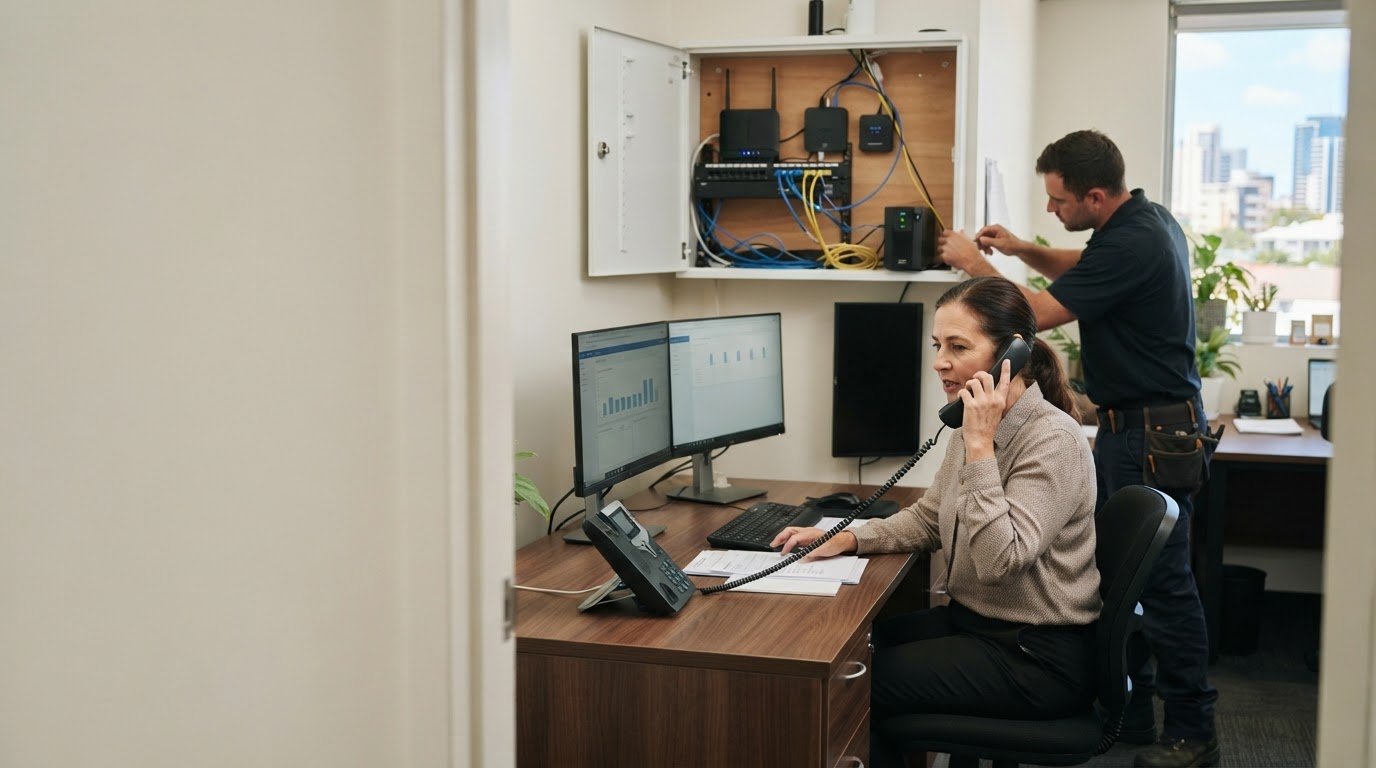
A phone-system backup is a copy of data; disaster recovery is the plan and capability to restore communications and business operations after a disruption. For disaster recovery for phone systems in Brisbane, that distinction matters: saved information alone won’t keep calls moving if the office loses power, internet access or access to cloud services.
It’s reasonable to expect a backup to help restore service, but recovery also depends on what happens while systems are unavailable. Your team needs to know where calls will go, how staff can keep answering them and who coordinates the response.
This article explains how backups differ from disaster recovery and outlines practical ways to test call failover and prepare for internet, power and cloud disruptions. It also covers recovery priorities, system dependencies and workable fallback options, helping your business make decisions before an outage puts communications under pressure.
Key Takeaways
- Separate data backups from the plans and steps needed to restore phone services and business operations.
- Test whether calls can reach staff through an alternative destination when the office loses internet or power.
- Set recovery priorities around the people, systems and suppliers your critical communication depends on.
- Plan for cloud and connectivity disruptions with clear call-routing options and a fallback your team understands.
What is the difference between backup and disaster recovery?
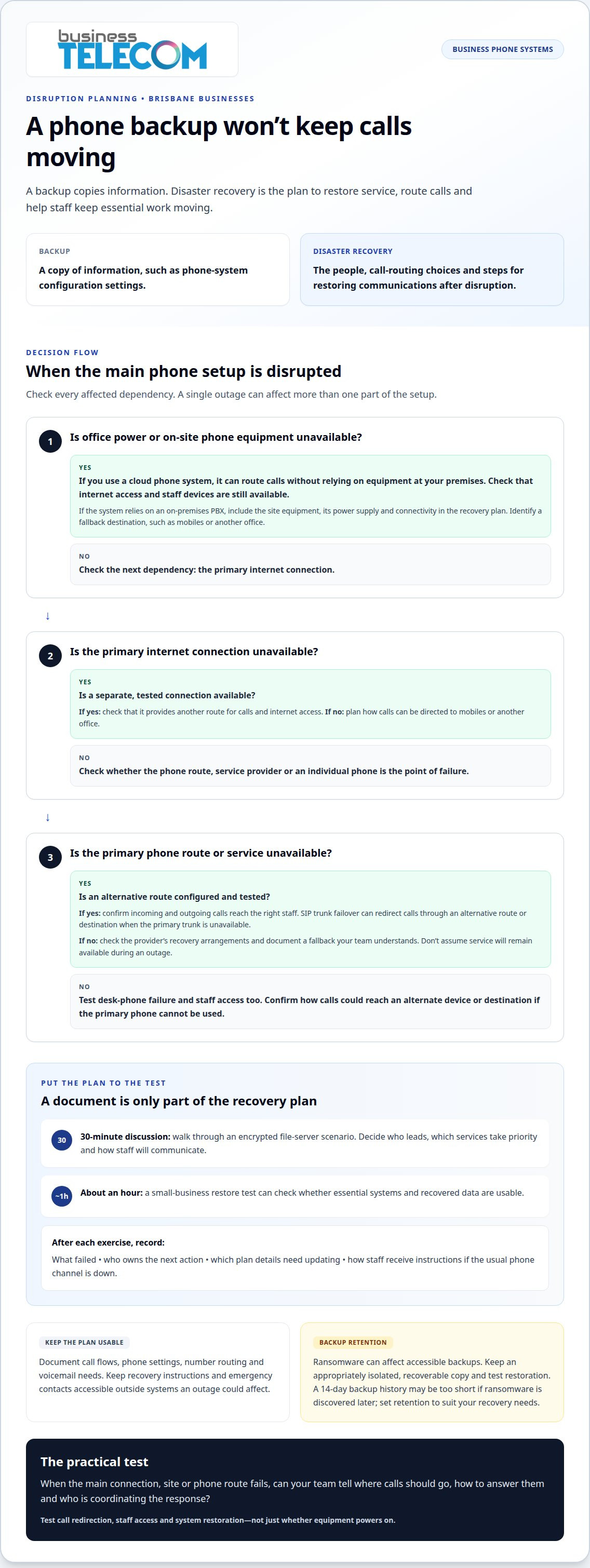
A backup is a copy of information; disaster recovery is the plan and capability to restore systems and business operations after disruption. For a phone system, a backup might preserve configuration settings, while recovery also covers call routing, staff access and the steps for restoring service.
Cloud phone systems can route calls without relying on equipment at your premises, which may help during a local power outage. An on-premises PBX relies on equipment at your site, so recovery planning must account for that equipment, its power supply and connectivity. Cloud services still depend on internet access and the provider’s infrastructure. Consider where backups are stored and whether an Australian data centre meets your business requirements.
Brisbane businesses can plan recovery for phone settings, number routing, voicemail and the connections staff use to answer calls. Document call flows, preserve configuration records and establish how staff can access essential messages or redirect incoming calls during an outage. The exact steps depend on your phone system.
Businesses looking for providers can consider telecommunications providers that supply business phone systems and recovery planning for the relevant setup. Compare what their plan covers, such as restoring configuration, rerouting calls and maintaining access when the main connection fails. No provider should be assumed to offer the same recovery arrangements.
Fibre, mobile and wireless connections can provide different paths for calls and internet access, but each needs to be included in the recovery plan. Mobile access, for example, may let staff answer calls if office internet is unavailable, while a separate connection may support essential services.
Ransomware can affect accessible backups as well as live systems. Keep an appropriately isolated, recoverable copy, and test that it can be restored. A 14-day backup history may be too short if ransomware is discovered later; set a retention period that suits your business’s recovery needs, or look to managed service providers such as ManagePoint to support broader data protection and security strategies.
Cloud disaster recovery and off-site backups can support recovery when office equipment is unavailable, but a copy alone won’t restore call handling. Identify the settings and voicemail your business needs, keep recovery instructions accessible outside the phone system, and test the restore process so the team knows what to do next.
How do you test a disaster recovery plan?
Test the plan by simulating an outage and checking whether staff can keep essential calls and tasks moving. Arrangements for Australian business phone outages and emergency calls depend on the service and circumstances. Don’t assume a business phone system will remain available during an outage; document another way staff can contact emergency services.
Business continuity covers the people, processes and workarounds that keep essential operations running. IT disaster recovery focuses on restoring technology, such as phone hardware, internet access and business software. As highlighted by IT disaster recovery specialists such as reisinformatica.com, a complete plan needs both: restoring a server won’t help staff answer customers if nobody knows where calls should go.
Build the disaster recovery plan around specific Brisbane scenarios. Test what happens if the main office loses power or internet, a desk phone fails, or an internet service provider outage prevents calls. Include flooding, bushfire risks relevant to your location and cyberattacks. For a multi-site business, test whether calls can be transferred to another office.
Run a practical exercise with staff, not just a document review. In a 30-minute discussion, walk through an encrypted file server scenario: who leads, which services take priority, and how staff communicate? A small-business restore test can take about an hour; use it to check that essential systems and recovered data are usable.
After each exercise, record what failed, who owns the next action and which plan details need updating. Train employees on what to do when the primary internet connection fails, including how they will receive instructions if the usual phone channel is down. Keep emergency contacts outside systems that an outage could affect.
For example, simulate a Brisbane office closure during severe weather. Have the incident lead confirm staff safety, activate the agreed call-routing fallback and tell employees how to handle urgent enquiries. The exercise should reveal gaps in business operations, not simply confirm that hardware powers on.
Disaster risk assessments and regular failover testing
Assess likely disruptions, system dependencies and the calls your Brisbane business must keep handling. Planning disaster recovery for phone systems in Brisbane starts by setting acceptable downtime and data-loss limits.
Internet redundancy and failover
Map how calls depend on your internet connection, phone infrastructure and staff devices. A secondary connection can provide another route if the primary service fails, but it needs a separate path and a tested configuration.
Automatic failover routing redirects calls to an alternative destination when a line, site or device becomes unreachable. Decide which destination suits each disruption, such as mobiles or another office, and test what happens when the primary connection drops.
SIP trunk failover
Phone-system failover can help keep calls reachable when a primary connection or route is unavailable. SIP trunk failover redirects calls through an alternative route or destination if the primary trunk becomes unavailable.
Include the trunk, internet service and call destination in the same risk assessment. Test incoming and outgoing calls, and confirm the fallback still reaches the right staff if the main site or connection is affected.
Failover testing and system restoration
Schedule structured scenario exercises and routine failover tests. Simulate a connection disruption, confirm calls redirect as planned, and record whether staff can answer using the alternate route.
Then test restoration: return to the primary connection, confirm normal call routing resumes, and check that system settings remain correct. Review results after significant infrastructure changes, update recovery steps and assign an owner to each unresolved issue.
Recovery time and point targets
A recovery time objective (RTO) helps a business consider how long it can tolerate a system disruption. A recovery point objective (RPO) is the amount of data, measured in time, the business can afford to lose.
Set each target according to call-handling needs and the information that must be restored. An RTO might be minutes, hours or a day; the right target depends on the impact of disruption. For disaster recovery for phone systems in Brisbane, assess hosted, VoIP and on-premises dependencies rather than assuming one target fits every setup.
Internet, power, cloud and phone system disruption scenarios
Different failures affect different parts of a phone system. If Brisbane premises lose power, desk phones and local network equipment may stop working even when cloud services remain available. Cloud-based call routing can operate independently of equipment at the site, but staff still need a working device and connection to answer calls. Plan how calls will reach mobile phones or another location when the office is inaccessible.
An internet outage can interrupt VoIP calls that rely on the affected connection. A backup connection may provide another route, but it must be available to the phone system and tested with real incoming and outgoing calls. Identify which connection supports critical communications, how staff will know a failure has occurred and where calls should go if the primary path is unavailable.
A cloud disruption requires a different response from a local equipment failure. Record how your business will handle calls if the cloud phone service or an administrator account is unavailable. A cyberattack or data corruption may affect phone settings and other systems, so keep recovery instructions accessible outside the affected environment. After recovery, confirm that call routing, voicemail access and key settings work as intended.
Brisbane’s flood history makes premises access a practical scenario to include: floodwater reached businesses in Woolloongabba, Rocklea, West End and East Brisbane during the 2011 and 2022 floods. Consider whether staff could work from another location, answer calls on mobile devices, and receive instructions without entering the site. Include severe weather, power loss, internet failure and cloud disruption in your testing, rather than testing only one device.
Map each disruption to a response: who leads, how calls are redirected, and how the team confirms normal service has returned. Discuss phone continuity options for your Brisbane business when reviewing how its phone system should handle outages.
Business Telecom: Business Phone System
Brisbane businesses reviewing how their teams handle calls can consider cloud-based business phone systems. If your current setup depends heavily on one office, connection or device, consider how a phone system can support continuity and the way your staff work.
Before making a change, outline which calls are critical, where staff need to answer them and which disruptions your recovery plan must address. These requirements provide a practical starting point for discussing a business phone system that supports everyday call handling and continuity planning.
If you’re reviewing phone system options for your Brisbane business, contact Business Telecom to discuss your requirements.
Turn your recovery priorities into a practical plan
The next step is to connect your continuity priorities with the phone system your team uses. Identify which calls matter most, how customers should reach the right staff and what temporary arrangements suit your operations. This gives decision-makers a clear basis for discussing system requirements.
Ask Business Telecom about its current Business Phone Systems, Business Land Lines and Office Phone Systems offerings. Consider whether any options suit how your team handles calls and the disruptions your business needs to plan for. Start with your current setup, call-handling needs and recovery priorities.
If you’re planning disaster recovery for phone systems in Brisbane, contact Business Telecom to discuss your requirements. A considered next step can help your team make informed decisions and build a phone continuity approach that fits the way your business works.
Frequently Asked Questions
How much does business continuity cost?
Business continuity costs vary according to the scope of arrangements and the resources needed to keep essential work operating. A business may need to account for staff time, alternate work processes, communications and technology changes. For businesses in Brisbane, costs depend on which activities need continuity and how existing systems can support them. There isn’t one fixed cost for every organisation.
How much does phone system disaster recovery cost in Brisbane?
The cost depends on the phone system in place and the recovery work required. Relevant factors may include configuration changes, equipment and connectivity requirements. Costs vary according to your circumstances. Before proceeding, clarify what work is included and whether the proposal addresses your business’s specific call-handling needs.
How can Brisbane businesses forward calls during a phone system outage?
Set the forwarding destination and caller experience in advance. Decide, for example, whether callers should hear a short service message before reaching a staff member, and nominate who handles urgent enquiries. Consider whether the destination can manage the expected call flow and whether staff know how to respond. Clear instructions help keep customer conversations consistent during a temporary change.
How do NBN, internet and power outages affect phone system disaster recovery in Brisbane?
The impact depends on where the interruption occurs. An NBN service issue, a fault in a business’s internal network and a premises power failure affect different parts of the connection path. Identifying the affected point helps narrow the response. Record which equipment and services depend on mains power, then note how staff can tell whether the problem is local or upstream.
What are the common risks and failure points in phone system disaster recovery plans?
Less obvious gaps can appear in call queues, after-hours schedules and voicemail handling. A fallback destination may receive calls but still leave callers without the right response if these settings are overlooked. Include business hours, public holidays and escalation paths in the plan. Reviewing a typical caller’s journey can uncover details a basic connection test won’t reveal.
How can a business test and maintain a phone system disaster recovery plan?
Test from outside the office network, taking a caller’s perspective rather than relying only on an internal status check. Confirm the greeting, routing destination and instructions staff receive. Record the outcome, any unexpected behaviour and who is responsible for follow-up. Repeat the exercise after changes to call flows or operating hours so the documented process reflects current practice.