

A cloud phone system can suit a Gold Coast law firm that needs flexible call handling for staff working in the office or remotely. A law firm VoIP solution on the Gold Coast gives your practice another way to manage business calls while accounting for confidentiality and day-to-day operations.
Choosing a system involves more than comparing call features. Consider how your firm handles client information and whether the support arrangements suit its daily work.
This guide covers practical decisions about costs, Australian data hosting, number porting and support to help you assess whether a cloud phone system suits your practice.
Key Takeaways
- Assess whether a cloud phone system fits your firm’s call-handling needs, work patterns and confidentiality requirements.
- Understand how Australian data hosting relates to handling client information and what to consider for your practice.
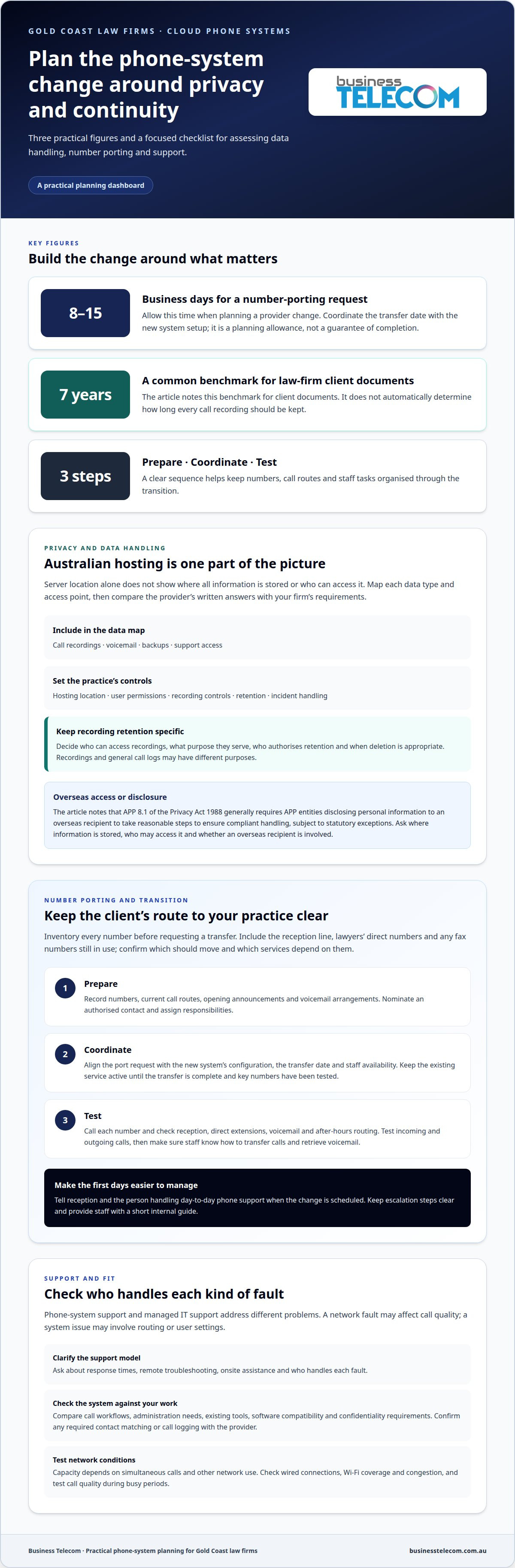
- Allow 8-15 business days for a number porting request when planning a provider change.
- Consider the support response times and onsite assistance your team needs before choosing a system.
Why Pay For A Law Firm Cloud Telephone System?
A paid cloud system can centralise call handling without requiring your firm to maintain an on-site phone exchange. The right setup depends on your team’s workflows, confidentiality requirements and existing network.
Paid cloud phone benefits
A hosted system lets staff manage business calls in the office or remotely, rather than relying on a single desk phone. Call routing can direct enquiries to the right person, while queues help manage calls when several clients contact the firm at once.
Managed IT support and phone-system support address different problems. A network fault, for example, may affect call quality, while a system issue may involve routing or user settings. Gold Coast practices should clarify whether support includes on-site assistance or remote troubleshooting, and who handles each type of fault.
Phone system and provider options
A hosted PBX runs on a provider’s cloud platform, while an on-premises PBX uses equipment maintained at the firm. Microsoft Teams Phone adds calling to a Teams environment. The best fit depends on your existing tools, administration requirements and call workflows.
If your legal practice management or CRM software needs to integrate with the phone system, confirm that it supports the required functions, such as contact matching or call logging. Gold Coast firms should compare a provider’s support model, number-porting process, data hosting and software compatibility rather than assume every system offers the same setup.
VoIP features and network requirements
Useful features may include call queues, voicemail, call recording and integrations with practice management or CRM software. Queensland call recording is governed by the Invasion of Privacy Act 1971, alongside the Act’s specific requirements and exceptions, according to Queensland Government. Recording settings should reflect the firm’s call-handling needs and relevant requirements.
There is no single internet speed requirement for every firm. Capacity depends on the number of simultaneous calls and other network use. Where possible, separate voice traffic, use a reliable router, and check wired connections, Wi-Fi coverage and congestion. Test call quality during busy periods, not just when few staff are online.
Client confidentiality and Australian data hosting
For a Gold Coast law firm, confidentiality depends on how calls and related information are handled throughout their lifecycle. Australian data hosting is one consideration, but server location alone does not explain where call recordings, voicemail, backups or support access are managed. Map each data type and access point before implementation.
An estate matter, for example, may involve sensitive details in a voicemail or recorded call. Decide who can access this material, how access is controlled and what happens when it is no longer needed. Address recordings separately from general call logs in the firm’s retention policy, as they may serve different purposes.
Seven years is a common retention benchmark for Australian law firm client documents, but the appropriate period for a particular call recording depends on the circumstances. Do not automatically apply that benchmark to every recording. A focused retention schedule can identify which records relate to a matter, who authorises retention and when deletion is appropriate.
APP 8.1 of the Privacy Act 1988 generally requires APP entities disclosing personal information to an overseas recipient to take reasonable steps to ensure compliant handling, subject to statutory exceptions. For a practice, this makes the provider’s data flows relevant: establish where information is stored, who may access it, and whether any overseas recipient is involved. These details support a more informed privacy consultation.
Before implementing a system, document the firm’s requirements for hosting location, user permissions, recording controls, retention and incident handling. Then compare the provider’s written answers against that list. A provider should be able to explain its data arrangements clearly; don’t treat a general statement about Australia hosting as a complete account of every data flow. To explore Australian VoIP options, consider how the system’s data handling aligns with your practice’s requirements.
Number porting and service transition
Keeping an established number helps clients reach the practice while its phone system changes. Allow 8-15 business days for a number porting request, then coordinate the transfer date with the new service setup. A planned transition benefits from clear roles, timing and staff communication.
Start by listing every number the Gold Coast practice uses, including the main reception line, lawyers’ direct numbers and any fax numbers still in use. Confirm which numbers should transfer and which services depend on them. A clear inventory helps prevent an important reception or matter-specific number from being missed.
For a law firm VoIP solution on the Gold Coast, organise the required account and number details, nominate an authorised contact and assign responsibility for each task. The transition plan should include:
- Prepare: Record the numbers, current call routes, opening announcements and voicemail arrangements.
- Coordinate: Align the port request with the new system’s configuration and staff availability.
- Test: After transfer, call each number and check reception, direct extensions, voicemail and any after-hours routing.
For example, if a client calls a lawyer directly about a contract, the call should still reach the intended person after the number transfers. Test incoming and outgoing calls from different handsets, and make sure staff know how to transfer calls and retrieve voicemail in the new system. A short internal guide can help employees during the first days of use.
Keep the existing service active until the transfer is complete and the practice has tested its key numbers. Tell reception and the person handling day-to-day phone support when the change is scheduled, and make the escalation steps clear. This helps the team report problems promptly and keep client communications organised.
Choose a paid cloud phone system that lets the practice retain control of its phone number and scale as it grows. OMB Solicitors has provided legal services on the Gold Coast since 1968 and has provided legal services to the Gold Coast City Council for over 20 years. AML/CTF obligations have applied to firms helping with property or company transactions since 1 July 2026.
Response times and onsite support
Review the contract for support hours, response targets, escalation steps and on-site arrangements. The service-level terms should explain how faults are prioritised, how updates are provided and what happens if an issue remains unresolved. A response target may describe acknowledgement rather than restoration, so clarify both.
Ask how support handles problems affecting reception, direct numbers or the phone application. A practice may need urgent help if incoming calls stop reaching reception, for example. The contract should identify the reporting channel, the information staff need to provide and who updates the nominated contact.
On-site support has its own practical considerations. Establish whether a technician can attend your Gold Coast premises, which faults require a visit and how access is arranged. A failed handset may need different troubleshooting from a network outage. For remote support, clarify how staff share diagnostic information and whether the process could expose confidential documents or client conversations.
The disaster recovery plan should explain how communication continues during an internet outage, power disruption or platform fault. Check the steps for reporting an incident, restoring service and informing staff. Discuss whether calls can be redirected to another number or location, and who authorises the change. Do not assume a backup arrangement exists unless the contract describes it.
Meet with the practice manager and the person responsible for IT to document key contacts, escalation paths and priority call flows. Include reception, lawyers’ direct lines and after-hours messages. Keep the support instructions with the system documents and ensure nominated staff can access them during an outage.
Clear support terms help a law firm assess whether the service matches its operating needs. Discuss phone system support requirements before deciding which arrangement suits your practice.
OMB Solicitors has supported, advised and acted for local Gold Coast businesses for over 40 years, offering a longstanding perspective on the service considerations local practices may weigh when reviewing support arrangements.
Business Telecom
Business Telecom can discuss phone-system requirements with Gold Coast practices, including call-handling needs, confidentiality priorities and support preferences. If you’re replacing outdated equipment or changing how calls are managed, discuss the available options with the provider.
For a law practice, the right setup should reflect how reception handles enquiries, where staff work and what happens when the usual call path is unavailable. Discuss requirements such as number porting, data hosting and support expectations before choosing a system. This helps clarify which details the proposed arrangement needs to address.
Contact Business Telecom to discuss phone system options for your Gold Coast practice.
Make a confident decision for your practice
A law firm VoIP solution on the Gold Coast should fit how your practice communicates, not simply add another technology platform. Before deciding, bring the partner, practice manager and reception staff into a focused discussion. Their day-to-day perspectives can clarify what the system needs to support and which trade-offs matter most.
Turn those priorities into a concise decision brief. Note the outcomes you value, the existing processes you want to retain and the changes your team is prepared to make. This gives you a practical basis for discussing options and assessing whether a proposed setup suits your practice’s operating style.
When you’re ready to discuss a phone system for your Gold Coast firm, contact Business Telecom to talk through your requirements. A considered next step can help your team move forward with clarity.
Frequently Asked Questions
How do VoIP providers protect confidential client calls and meet Australian security requirements?
Ask the provider how it protects call data, controls staff access and handles security incidents. For a law firm, consider who can access call records and how permissions change when someone leaves. Record the answers alongside your privacy procedures and assess them against the firm’s confidentiality obligations. Australian data hosting alone does not explain every access or data-handling arrangement.
What steps are involved in porting an existing Gold Coast business phone number to VoIP?
First, identify the business numbers clients use and where each appears, such as in email signatures, on letterheads and in online listings. Coordinate the transfer with the new service, then update staff instructions and client-facing materials if call routing changes. Record who is responsible for number administration so future changes do not rely on one employee’s memory.
How should Gold Coast businesses assess VoIP support and service arrangements?
“Local support” can mean different things, so distinguish phone or remote assistance from on-site attendance when assessing service arrangements. Consider whether the provider clearly explains fault reporting, escalation and continuity options in terms that suit your practice.