
For predictable phone system billing in Sydney, monthly per-user pricing gives your business a recurring charge based on the users covered. Break-fix billing links charges to faults or repairs, which can make spending harder to plan. The better fit depends on the service arrangement, how your team uses its phones and which charges sit outside the regular fee.
A monthly amount can look straightforward, but the billing model alone won’t show your full commitment. The contract sets out the service terms, while bills and invoices show how those terms apply in practice. Reviewing all three gives you a clearer picture of recurring charges, variable usage and changes that could affect your budget.
This guide compares break-fix and monthly pricing, explains how per-user charges work, and highlights practical checks for bills, contracts and invoices. It also shows how to assess fixed-monthly options from Sydney providers against your business requirements. Use this framework to discuss phone system billing and decide which arrangement warrants closer consideration.
Key Takeaways
- Compare break-fix charges with recurring pricing by looking at how each handles repairs, ongoing service and variable call costs.
- Understand how per-user billing counts users and which phone system components may be charged separately.
- Review bills, contracts and invoices for the inclusions, usage charges and terms that affect your total spend.
- Assess fixed-monthly options by comparing what each provider includes, rather than relying on the billing label alone.
Break-fix billing compared with predictable monthly costs
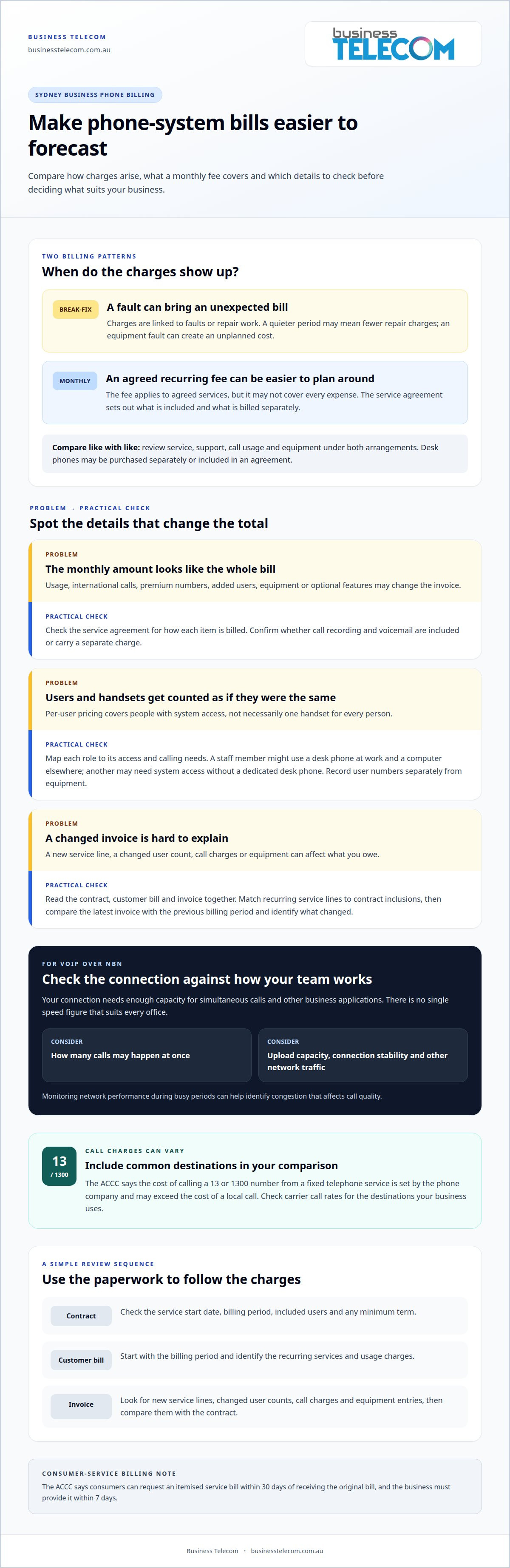
Break-fix billing charges your business when a fault needs attention or repair work. A quiet period may bring fewer repair charges, while an equipment fault can create an unexpected bill. Monthly pricing instead sets a recurring charge for agreed services. It can make that part of the budget easier to plan, but the agreement determines what falls outside the recurring fee.
Compare both arrangements against the same requirements: service, support, call usage and equipment. Desk phones may be purchased separately or included in an agreement, so factor them into the comparison. For example, a business replacing several ageing handsets should distinguish equipment costs from ongoing service charges.
VoIP carries calls over an internet connection, while a cloud phone system hosts the service online. Traditional landlines use fixed telephone services. The practical difference is the connection and equipment each setup relies on. Suitability depends on your existing arrangements, call patterns and how staff need to work.
A fixed monthly charge may not cover every expense. Usage, international calls, premium numbers, added users, equipment or optional features can change the invoice. Check the service agreement to see how each item is billed, rather than assuming the monthly amount covers every call and component.
Carrier selection affects call charges. According to the Australian Competition and Consumer Commission, the cost of calling a 13 or 1300 number from a fixed telephone service is set by the phone company and may exceed the cost of a local call. Include your business’s common destinations when comparing carrier call rates.
Call recording and voicemail aren’t universal inclusions in Sydney business plans. Check the plan schedule to see which features are included and whether any carry a separate charge. A written list of required functions helps you compare plans without assuming they’re automatically included.
Monthly per-user phone system pricing
Monthly per-user pricing applies a recurring charge to each person covered by the phone system agreement. The user count represents system access, not necessarily the number of handsets. For example, a staff member might use a desk phone at work and a computer elsewhere, while another employee may need system access without a dedicated desk phone.
Before comparing plans, map each role to its calling requirements. A receptionist may need a desk phone and call-transfer access, while a staff member who makes occasional calls may have different needs. This helps establish the number of users and the equipment your team requires, without assuming one phone per employee.
The monthly amount depends on the service scope and billing rules. Check how the agreement treats new users, departures and changes in access. If your business brings in an employee, identify whether that changes the user count, service charge or both. Keep this billing rule alongside your staffing forecasts.
If your Sydney business uses an NBN connection for VoIP, it needs sufficient capacity for simultaneous calls and other business applications. No single speed figure suits every office: call concurrency, upload capacity, connection stability and other network traffic all matter. Monitoring network performance during busy periods can help identify congestion that affects call quality.
Build a comparison around the same user roles, required access and connection needs for each proposal. Record the user count separately from desk phones, then note which functions each role needs. If your team uses a mix of office and remote calling, include both situations in the requirements. This creates a more useful basis for assessing monthly per-user pricing than multiplying a headline rate by the number of employees. Explore cloud phone system options if your team needs a clearer view of its requirements.
Customer billing, contracts and invoices
Use the service contract, customer bill and invoice together to understand phone charges. Start with the billing period, then match each recurring service line to its contract inclusion. A recurring user charge, for example, should be distinguishable from call usage, equipment or a one-off change. In Australia, this paper trail helps your accounts team identify what changed between periods.
Australian phone services use 000 for emergency calls. Number porting transfers a phone number between services; the contract and transfer arrangements should make clear which service remains active during the change. These are separate from billing rules, so review continuity, charges and emergency calling arrangements as distinct points.
For consumer services, the ACCC says consumers can request an itemised service bill within 30 days of receiving the original bill, and the business must provide it within 7 days. An itemised bill can help explain individual charges. Keep the original bill and request together so the dates and billing period are clear.
- Contract: Check the service start date, billing period, included users and any minimum term. Compare each item with the latest invoice.
- Invoice: Look for new service lines, changed user counts, call charges and equipment entries. For example, a handset added during the period may appear separately.
- Number transfer: Record the numbers being moved and the planned transfer date in the service paperwork. This helps your team track the change and query a charge against the correct service.
If your Sydney business receives a higher invoice, compare it with the previous period before disputing a line. Identify whether the change came from a new user, call usage or a contract variation. Clear records help accounts staff explain the difference and make future phone system bills easier to review.
Which Sydney business phone providers offer fixed monthly pricing?
Sydney providers offering cloud or hosted VoIP systems may package service as a recurring monthly subscription. The written proposal and service agreement show whether pricing is fixed, per user or based on another billing unit. Compare the documents, not just a plan label or sales summary.
For a useful shortlist, look for providers that state the billing unit and explain what the recurring charge covers. A small office, for example, may need fewer handsets than system users if staff also call through computers or mobile devices. Ask how the proposal counts users and handles changes.
Then compare the service scope. A provider may bill call usage, equipment, setup or optional functions separately from the monthly service charge. That doesn’t automatically make the arrangement unsuitable, but these items affect how closely the regular bill matches the quoted recurring amount. Keep every component visible in your comparison.
- Billing basis: Is the recurring amount charged per user, service or another stated unit?
- Included services: Does the proposal identify call handling, voicemail, support and any other required functions?
- Equipment: Are desk phones part of the arrangement, purchased separately or retained from your current setup?
- Changes: How does the agreement account for added users, removed users or changed requirements?
For predictable phone system billing in Sydney, request a written breakdown separating recurring charges from usage and one-off items. Compare proposals using the same user count, equipment needs and call requirements. This makes differences between providers easier to understand without relying on headline pricing alone.
A fixed monthly model may suit a business that values a defined recurring service charge. A business with changing needs or a preference for paying for repair work as it arises may weigh the trade-offs differently. The agreement’s inclusions and billing terms determine whether the model fits.
Ask about phone system options for your Sydney team.
Contact Business Telecom to confirm whether it currently offers cloud-based VoIP phone systems and how recurring charges are documented in its plans and agreements.
Business Telecom: Business Phone System
Business Telecom serves Sydney businesses considering a business phone system. Contact the provider to confirm whether business landlines, office phone systems and small business phone systems are currently available.
You can ask whether a requirements discussion can cover how many people need system access, whether staff need desk phones and which call-management functions matter to your business. You can also ask about recurring services, equipment and usage charges, including what each charge covers.
If your current arrangement makes phone costs difficult to plan or understand, contact Business Telecom to confirm whether it can discuss your Sydney business’s requirements.
Make your next phone system decision with confidence
A phone system review is an opportunity to align communications with how your business operates. Consider upcoming staffing changes, flexible work arrangements and how customers reach your team. These priorities can guide a practical discussion about predictable phone system billing for Sydney businesses, without making the monthly charge the only measure of fit.
Bring your current service agreement and a recent invoice to the discussion. They provide a starting point for assessing how your existing arrangement supports your requirements and where a different setup could make costs easier to understand. Business Telecom can talk through phone system options for your business.
There’s no need to settle every detail before starting. A clear conversation can help you identify the points that matter most and decide on a sensible next step. Contact Business Telecom to discuss your phone system requirements and move towards a setup that fits the way your team works.
Frequently Asked Questions
What does predictable phone system billing mean for Sydney businesses?
For a Sydney business, predictable phone system billing means you can forecast recurring service charges and understand what could make them vary. Compare a typical billing period with a busier one, including call usage and staffing changes. This helps you decide whether your budget needs room for variable charges, rather than treating the recurring amount as the full phone system cost.
What are the monthly prices for business phone systems in Sydney?
Monthly pricing depends on the system scope, including users, call inclusions, equipment and selected features. To build a useful budget, define who needs system access, which devices they’ll use and what functions your team requires. Then compare written proposals based on the same requirements. This helps you assess the total arrangement without mistaking different inclusions for equivalent monthly pricing.
Are Australian business phone plans charged per user, per line or per minute?
Plans may use per-user, per-line or usage-based charges, or combine these billing methods. A user charge relates to access for a person; a line or call-path charge relates to the system’s capacity for calls. Per-minute charges relate to call usage. Check which unit appears on each service line, and separate access charges from call charges when reviewing your bill.
What contract terms, cancellation fees and price increases should Sydney businesses check?
Review the agreement’s term, renewal process and notice requirements, then check for early-exit fees and how they’re calculated. See whether the agreement explains how price changes are handled and when they take effect. Also note equipment commitments or number-transfer arrangements. These details help you understand the financial and practical steps involved if your business changes its phone system.