

A local call isn’t always billed as a separate per-minute charge. For local call rates for a business in Brisbane, the key is the destination: calls to local numbers are often included in landline and mobile plans, while calls to mobile, national and international numbers may be charged differently.
That makes the advertised call rate only part of the picture. Brisbane landline numbers use the (07) area code, and the cost of calls from a business line depends on the plan and the type of number being called. Calls to 13 and 1300 numbers can also be treated differently from standard local calls.
This guide explains how local and national calls are commonly billed, what to check in plan inclusions, and how setup and contract terms affect your decision. It also covers how a business phone system can manage calls across a front desk, mobile phones and multiple sites, helping you assess what suits the way your Brisbane team works.
Key Takeaways
- Separate line rental, call charges and equipment when comparing business phone options to understand what contributes to the overall cost.
- Review setup fees, contract length and number-porting terms together so you can assess the practical and financial impact of switching.
- Check how your plan treats calls to mobiles, 13 and 1300 numbers, and voicemail services before estimating your regular call spend.
- Match your phone system to how your Brisbane team answers, transfers and manages calls across desks, mobiles or multiple sites.
Australian business VoIP plan and line-rental prices
Australian VoIP costs can include a recurring line or user fee, call usage, equipment and setup. App-based services and pay-as-you-go lines may include different features, so compare what each charge covers. For a Brisbane business, the monthly fee alone won’t show the full cost of handling calls.
VoIP carries calls over an internet connection, including an NBN service. Call quality can be affected by connection performance, network congestion and the capacity used by other online activity. For example, a team making calls while transferring large files should consider how both activities share its connection. A stable connection supports clearer conversations, but VoIP quality also depends on the local network and system setup.
A cloud PBX is a phone system hosted online. Hosted PBX and VoIP can let staff answer, transfer and manage inbound calls without relying solely on a traditional office exchange. A business can direct calls to a front desk, another team member or a mobile, depending on the system’s configuration. Brisbane numbers commonly use the (07) area code; keeping an existing business phone number may also be part of planning a move.
Equipment is another cost to consider. A VoIP desk phone connects directly to the system, while an adapter can connect some analogue handsets. Whether you need new handsets depends on your existing equipment and chosen system. Setup charges may also apply, so separate one-off costs from recurring line charges when estimating total spend.
Use these steps to compare plans on equal terms:
- List the users, handsets and business phone numbers your team needs.
- Separate line rental from call charges, equipment and setup.
- Review included calls and any charges for destinations your team regularly contacts.
- Consider how inbound calls should reach staff at desks, on mobiles or across sites.
This breakdown helps you assess system costs against your call patterns and day-to-day requirements.
Setup fees and contract terms
Setup charges and contract length affect the cost of changing a business phone service. Separate one-off activation or configuration charges from recurring line fees and call costs. The total can also depend on how many phone numbers you transfer, whether existing handsets are suitable, and what call handling your team needs. A Brisbane business transferring a landline and several service numbers has different setup considerations from a new office starting with one number.
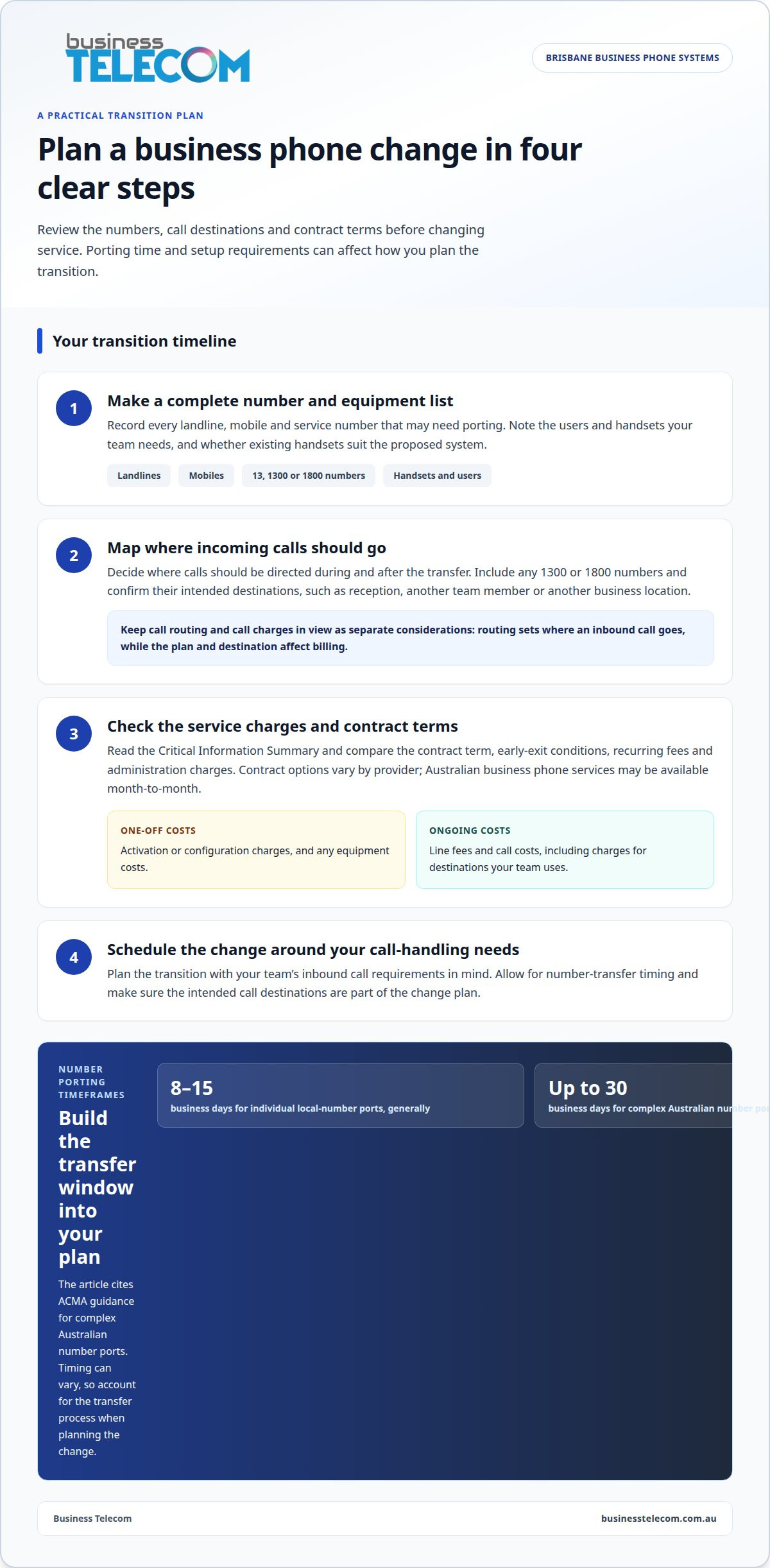
Number porting moves an existing phone number to a new service. Individual local-number ports are generally completed within 8 to 15 business days. According to ACMA, complex Australian number ports can take up to 30 business days, with limited exceptions. Plan the transition around that process, especially if customers rely on a published landline number or inbound calls during business hours.
Special service numbers need attention too. A business using 1300 numbers or 1800 numbers should include them in its porting and call-routing plan. These numbers can direct callers to an appropriate destination, such as a reception team or another business location. Confirming the intended destination before a change helps prevent a gap between the number transfer and the call handling arrangement.
Contract options vary by provider, and Australian business phone services may be available month-to-month. A shorter commitment can offer flexibility, while a longer term may have different setup conditions. Read the Critical Information Summary for the service’s charges and inclusions, then compare the contract term, early-exit conditions, recurring fees and administration charges.
Use this sequence to assess the change:
- List every landline, mobile and service number that needs porting.
- Identify where inbound calls should go during and after the transfer.
- Review the Critical Information Summary and contract terms for charges.
- Schedule the change to suit your team’s call-handling requirements.
This process gives your business a clearer view of the transition, from number-transfer timing to the terms that shape ongoing flexibility.
External call billing
External call charges depend on the number called and your plan’s inclusions. Whether a call from an Australian landline to a Brisbane (07) landline is charged at a local rate depends on the originating service and its plan. Mobile charges also vary by provider. Check how your plan defines included calls and which destinations they cover.
For landline customers, local calls may have a fixed cost regardless of call duration, depending on the service and plan. Other destinations may have different rates or billing rules. This makes the destination and plan terms important when estimating regular call spend.
Calls to service numbers need separate attention. Some plans include calls to 13 and 1300 numbers; others exclude them or apply limits. Charges may apply once an inclusion limit is exceeded. Calls to 1800 numbers from Australian landlines are usually free, though plan limits can affect charges. A 1300 call can also cost callers differently depending on whether they use a landline or mobile.
Voicemail can affect billing too. A telco may charge a connection fee when a call reaches voicemail, message bank or voice-to-text. Charges may also apply when the called phone is engaged, switched off, out of range or unanswered. These fees can apply even when the caller doesn’t speak to a staff member.
A business phone system’s routing determines where inbound calls go, but it doesn’t automatically determine the caller’s charge. Treat call handling and billing separately: routing may send an inbound call to a mobile, while the plan and destination affect the charge. A desk phone doesn’t change the external rate. Review call records by destination to identify which numbers and call outcomes contribute to usage costs.
Local and national outbound call rates
Calls to Brisbane mobile numbers are billed according to the mobile-call terms in your plan. A mobile number isn’t a Brisbane landline just because its owner lives or works in Brisbane. For example, assess a call to a customer’s mobile as a mobile destination, rather than assuming a local landline rate applies.
For local and national calls, use your plan’s definition of a local destination rather than relying only on the number’s area code. Brisbane landlines commonly use 07 numbers, but the number prefix alone doesn’t establish how a particular outbound call is categorised. National calls to other Australian destinations should be considered separately in your call-cost planning.
To reduce avoidable local phone costs, look at why and how often staff call. If two employees repeatedly contact the same supplier about one order, agree who will manage those updates. This can reduce duplicate conversations while preserving calls that need a direct discussion.
For national calls, consider the business purpose as well as the destination. A Brisbane team contacting a regional service provider may need a detailed conversation, while a routine appointment confirmation could suit another channel. Set sensible calling practices around the work, rather than discouraging calls that support customers or operations.
Use this review to turn call activity into practical changes:
- Separate mobile destinations from Brisbane landlines in your usage review.
- Identify repeated calls about the same customer, order or supplier task.
- Agree when a call is necessary and when another business communication method fits.
These steps help your team make deliberate outbound calls while preserving direct contact where it matters. For a Brisbane business, the useful comparison is how destinations and call purposes fit its calling arrangements, not a single rate viewed in isolation.
Business Telecom
Business Telecom helps Brisbane businesses consider phone system options that fit their call patterns, team structure and day-to-day requirements. If you’re reviewing local and national call charges, look beyond the rate: user numbers, how calls reach staff and whether employees work across locations all shape the setup your business needs. A suitable business phone system can help manage inbound enquiries and give your team a clear way to handle calls between office and mobile users.
Business Telecom provides business phone systems for businesses reviewing or updating their communications. The right choice depends on how your team makes and receives calls, and what equipment and call-handling approach suit your operations. Contact Business Telecom to discuss your Brisbane business phone requirements.
Make your next phone plan decision with confidence
Your next step is to connect call billing with the way your team works. Consider which destinations matter most, how staff need to handle customer calls, and whether your current setup can support those needs as the business changes. This gives you a practical basis for evaluating local call rates for businesses in Brisbane, rather than treating the lowest advertised rate as the only measure of value.
Use that perspective to choose a phone system that suits your business, rather than adapting daily call handling around a plan. Contact Business Telecom to discuss your team’s requirements and business phone system options.
Start a conversation with Business Telecom about your options, and take the next step towards a phone setup that fits the way you work.
Frequently Asked Questions
What are local landline call rates for Brisbane businesses in Australia?
There isn’t one standard rate for every Brisbane business landline. The amount depends on the specific service and plan. To identify the applicable charge, match a billed call to the plan for that phone line, then check its rate schedule. This is particularly useful when your business has several lines on different plans or older services.
How much do Australian business phone plans charge per local call?
There’s no single per-call amount for all Australian business phone plans. Your invoice and plan details show the charge for your service. To estimate the effect on your budget, review a representative billing period and count the local calls billed against the relevant line. This gives you a practical estimate based on your business’s own call activity.
Do Brisbane business phone providers charge per-call fees or include local calls?
Plan terms determine how local calls appear on your bill. Check the service description and call-charge entries, rather than relying on a plan name or headline. If several lines have different arrangements, review each one separately. This can help explain why similar calls appear differently across one business account.
How do local call rates compare across Brisbane business phone providers?
Compare equivalent services and billing terms, not just advertised rates. Use the same call pattern for each comparison, such as the same number of calls and similar destinations. Check whether the quoted amount applies to the same type of line and service. This makes the comparison more relevant to your business than comparing figures with different assumptions.
Do business VoIP plans in Brisbane include unlimited local calls?
Some VoIP plans may include local calls, but unlimited calling depends on the plan terms. Read the inclusions for the specific service and note any exclusions or usage conditions. If your team uses both desk phones and calling apps, make sure the stated allowance covers the way those users place calls.
How are local calls defined and billed by Australian business phone providers?
Providers define local calls under the terms of each phone service. A Brisbane number’s 07 prefix can help identify its geographic area, but it doesn’t by itself establish how every plan classifies a call. Businesses with lines at different sites should consider each line’s service address and applicable plan definition when interpreting call records.