
A business landline connection in NSW doesn’t always require a fixed phone line at your premises. Through Business Telecom, a virtual business number can direct calls to an existing phone, giving customers a dedicated business contact without relying on a traditional desk line. The right setup depends on how your business handles calls and which devices it already uses.
This decision applies to workplaces across NSW, from a Sydney office to a regional business. Businesses comparing options with teams or customers across the state will also need to consider how staff answer calls across locations. These local contexts are useful when assessing your own requirements, but connection options depend on the workplace and service.
This guide explains the practical differences between a dedicated business number and a personal mobile, what can affect setup and monthly charges, and how existing phone equipment may fit. It also outlines what to decide before changing services, including who needs to answer calls and whether you want to keep your current number. Use these details to identify a connection that suits your business.
Key Takeaways
- A business number can route calls to an existing mobile, so a fixed phone line at your premises isn’t always necessary.
- A dedicated number can separate work calls from personal calls and give a team a shared point of contact.
- Setup and ongoing costs depend on the type of service and what your business needs included.
- Find out when a simple number may suit your needs and when a business phone system could be a better fit.
Australian business landline numbers without fixed phone lines
NSW businesses can use virtual numbers, traditional landlines or internet-based calling. The right connection depends on the premises, existing phone equipment and how staff need to answer calls.
Keeping an existing business number
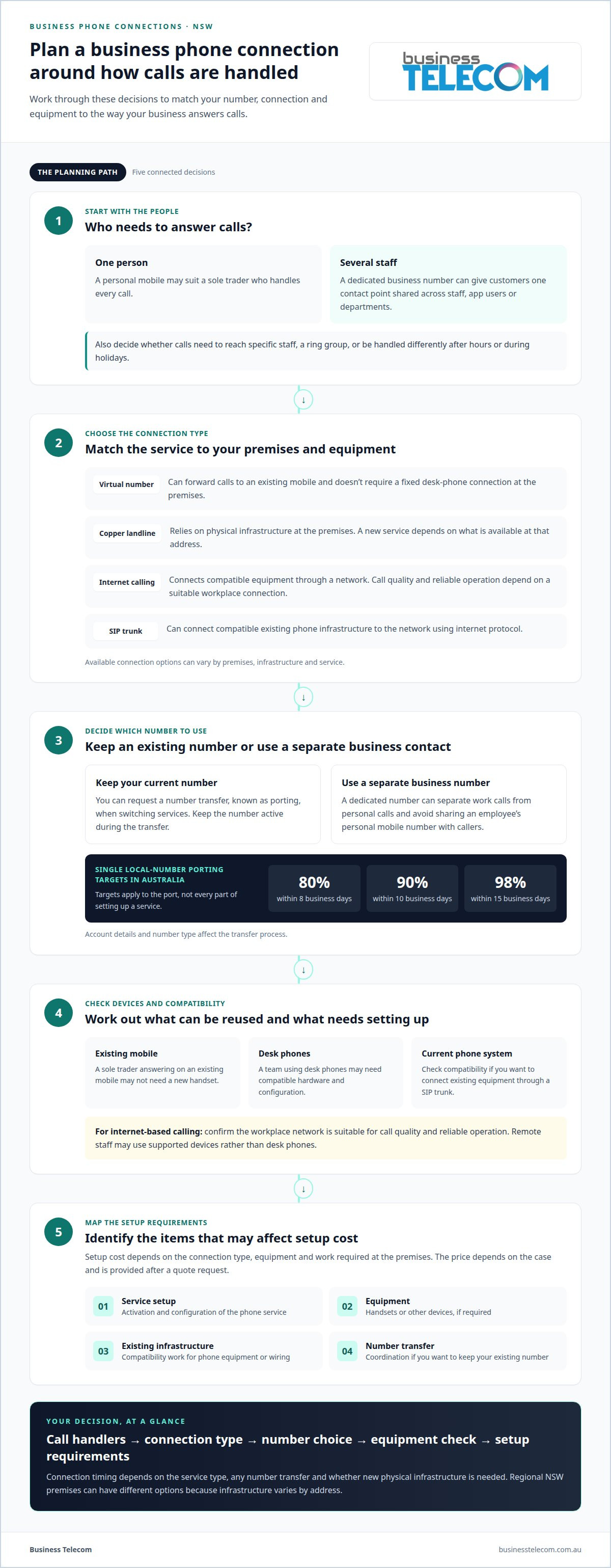
You can request to transfer an existing number when switching services. This is called number porting. For a single local-number port in Australia, porting targets are 80% within 8 business days, 90% within 10 business days and 98% within 15 business days. These targets apply to the port, not every part of setting up a service.
Keep the number active during a transfer. Account details and number type affect the process. A sole trader moving from a personal mobile can choose whether to retain that number or use a separate business contact.
Choosing a business phone provider
Australian business phone services offer different connection types and call-handling options. Consider whether calls should reach one person, several staff or an existing phone system. A sole trader may need a simple route to one device, while a team may need calls directed to specific staff.
For SIP trunking, check that it is compatible with your existing phone system. A SIP trunk connects compatible phone infrastructure to the network using internet protocol. This can suit a business that wants to keep using its current system rather than replace it.
Available NSW landline connection types
Options include a traditional copper landline, a virtual number that forwards calls, or internet-based calling. A copper connection relies on physical infrastructure at the premises, so a new service depends on what is available at that address.
Internet-based calling connects compatible equipment through a network. A virtual number doesn’t require a fixed desk-phone connection at the premises. The suitable option depends on existing infrastructure, equipment and how calls need to reach staff.
Connection timing and regional availability
Connection time depends on the service type, any number transfer and whether new physical infrastructure is needed. Porting timeframes for a single local-number transfer don’t cover the full setup of every new service.
Regional NSW addresses can have different connection options because infrastructure varies by premises. The address and connection type shape the setup. If a fixed connection isn’t suitable, a virtual number routed to an existing mobile is another option.
Dedicated business numbers versus personal mobiles
A personal mobile can work well for a sole trader who handles every call. As a business adds staff, however, work and personal calls can become difficult to separate. A dedicated business number gives customers a consistent contact point without sharing an employee’s personal mobile. It can also be shared across staff, app users or departments.
Consider a two-person consultancy: both staff members can answer calls to one business number instead of directing every enquiry to the owner’s handset. Call routing can send incoming calls to individuals or a ring group. Business-hour schedules can direct calls differently outside working hours or during holidays.
- Privacy: staff can handle business calls without giving callers their personal mobile numbers.
- Call handling: shared access and routing help direct a caller to the right person.
- Follow-up: voicemail and call history online can help staff review unanswered enquiries.
A virtual number can support outbound calls through an app using the business caller ID, helping keep customer calls separate from personal ones. Voicemail messages can also be sent to email, giving staff another way to follow up. Available functions depend on the service selected.
Using one personal mobile may suit a sole trader with a small contact list. A useful planning point is to set up a separate business number before 200 clients are saved under a personal mobile. That makes it easier to manage customer contacts and business call charges separately as the business grows.
Choose based on who answers calls, whether more than one person needs access, and how callers should be handled after hours. For a more structured approach, explore business phone system options for shared call handling.
Landline setup cost
Setup cost depends on the connection type, equipment and work required at the premises. A virtual number forwarded to an existing mobile has different setup needs from a dedicated desk handset connected through a phone system. The price depends on the case and is provided after a quote request. Key cost factors include equipment, installation requirements and the number of users or devices.
For example, a sole trader answering calls on an existing mobile may not need a new handset. A team using desk phones may need compatible hardware and configuration. A business connecting an existing phone system through a SIP trunk may have different requirements again.
Internet-based calling also depends on the network at the workplace. Call quality and reliable operation depend on having a suitable connection. Remote staff may use supported devices rather than desk phones, while an office team may prefer dedicated handsets. These choices affect what needs to be configured and supplied.
Before arranging a connection, separate the likely setup items:
- Service setup: activation and configuration of the phone service.
- Equipment: handsets or other devices, if required for the chosen setup.
- Existing infrastructure: compatibility work for current phone equipment or wiring.
- Number transfer: coordination if the business wants to keep its existing number.
Not every business needs new equipment. An existing handset may work with the selected service; otherwise, it may need replacing. A premises with existing phone infrastructure can have different installation requirements from a new office without cabling or phone devices.
To understand the setup involved, map where calls should ring, who needs to answer them and which devices they’ll use. Include remote staff and any existing phone system. This gives Business Telecom a practical basis for identifying configuration, equipment and connection requirements, rather than treating every NSW business as the same.
Monthly rental and minimum cost
The minimum monthly cost depends on the phone service and your business’s needs. A virtual number that forwards calls to an existing phone differs from a system with several users, physical handsets and shared call routing. The number of users and devices, call-handling requirements and existing equipment all affect the monthly arrangement.
For a sole trader, the main requirement may be one dedicated business number that forwards to a mobile. A small team may need several users to answer that number, with calls routed between staff. These different arrangements affect what the monthly service needs to cover, even if both businesses use a single public number.
Separate recurring charges from setup and equipment costs. A monthly rental may cover access to a number or phone service, while calls, hardware or other included services can affect the overall bill. Check the inclusions rather than focusing on the word “minimum”. Compare each service component with how your team handles calls.
- Number and users: identify whether the service covers one number, several users or both.
- Call handling: account for forwarding, shared answering and any routing requirements.
- Equipment: separate handset or device requirements from recurring service charges.
- Usage: understand how outbound calls and other chargeable use appear on the bill.
Changing a phone service doesn’t always mean replacing physical equipment. An existing handset or phone system may work with some connection types, while other setups rely on mobile devices and internet-based calling. This can change the balance between recurring and one-off costs. Keep your business number, users, devices and call requirements clear when discussing a monthly arrangement.
For a tailored breakdown of service requirements and costs, request a phone service quote.
Business Telecom: Business Land Lines
Business Telecom offers Business Land Lines for NSW businesses assessing how to handle calls without relying on a fixed phone setup. If you’re a sole trader needing a dedicated business number, or a small team reviewing its office phone arrangements, the right option depends on your number, users, equipment and call requirements.
For broader calling needs, Business Telecom also provides business phone systems, office phone systems and small business phone systems. These options suit teams that need a business-focused setup rather than relying only on personal mobiles. Share your requirements with Business Telecom to discuss a service that fits your business and existing phone arrangements.
Contact Business Telecom to discuss your business landline requirements.
Make your next phone decision with confidence
A business landline connection in NSW is also a decision about how your business presents itself to customers as it changes. Assign someone responsibility for the number, its call settings and updating them when staff roles or business hours change. Clear ownership helps keep your communications aligned with how your team works.
Before making a change, write down what you need from your phone service. A clear brief makes it easier to discuss suitable arrangements and how the number should support your business as its needs develop. Take your brief to Business Telecom to discuss your requirements.
Talk with Business Telecom about your business number and take the next step towards a phone setup that fits your work.
Frequently Asked Questions
Can I just get a phone line with no inclusions?
Yes. You can choose a voice-only service rather than a bundled phone system. Be clear about whether you need basic incoming and outgoing calls or also voicemail, shared users, schedules or call handling. For a sole trader with one handset and no receptionist workflow, extra features may add complexity without meeting a current need. Define the features you’ll use before comparing service plans.
Is a VoIP number the same as a landline number?
A VoIP number can appear to callers as a business landline number, but VoIP describes how calls are carried, not the type of number displayed. For example, a business can present a geographic number while calls travel over an internet connection. The customer-facing number and the technology carrying the call are separate choices, so consider which matters for your communications.
My ISP gave me a phone port with my NBN, is that enough?
Not necessarily. The port needs an active voice service, and the connected handset must work with the equipment. Before relying on it as your main business contact, test incoming and outgoing calls, caller ID and voicemail. If staff may need to speak with different callers at once, establish how many simultaneous calls the service supports and whether that suits your workflow.
What happens to my phone if the power goes out?
An internet-based phone service can stop working if the modem, router or connected phone equipment loses power. A cordless handset may also depend on a powered base station. Keep a charged mobile available as a separate contact option, and include power arrangements in your continuity planning. Businesses relying on VoIP should also establish whether their specific service allows calls to 000.
Which providers offer business phone services in NSW?
Business Telecom provides business phone services in Sydney, Brisbane and the Gold Coast. When assessing a phone setup for your NSW business, focus on the call outcomes you need and how the service will support them. A sole operator’s requirements, for example, differ from those of an office where several staff manage incoming enquiries.
How much does a business landline cost in NSW, including setup and monthly fees?
There isn’t one total that applies to every business. Request an itemised quote that separates one-off charges from recurring charges to understand the full commitment. Ask for the billing period, GST treatment, included call usage and any minimum term. This gives you a clearer basis for comparing the overall arrangement, rather than judging it by the monthly rental alone.