

A VoIP switch doesn’t have to mean giving up the landline number your customers already know. If you’re searching for “keep landline number switching to voip”, arrange the transfer before cancelling your existing service. Get the sequence wrong and you could put customer access at risk.
It’s reasonable to want certainty before making a change: not every number or service follows the same porting process. This guide explains how number porting works in Australia, what to confirm with your current and new providers, and how to plan a controlled move that helps protect incoming business calls.
You’ll learn what can affect eligibility, what details may be needed to authorise a transfer, and why your old service should stay active until porting is complete. We’ll also cover practical checks, including whether your phone line is linked to your internet or other equipment. With the right questions and a clear handover plan, you can move to a business VoIP system with fewer surprises.
Key Takeaways
- Keeping your number when you switch to VoIP is often possible, but ask the new provider to confirm eligibility for your specific number and service.
- To keep your landline number switching to VoIP, gather your latest phone bill, account holder details and exact numbers before starting the port request.
- Check whether the phone line supports internet, fax, alarms or EFTPOS so you can plan for any connected services before the changeover.
- Agree on a transition window with providers and brief staff who handle customer calls. Porting isn’t a guaranteed zero-interruption event.
- Compare providers’ number checks, porting coordination, progress updates and escalation contacts. Test the transferred number before reviewing your old account.
Can you keep a business landline number when switching to VoIP?
Often, yes. Australian businesses can commonly transfer an existing number to a new provider, but confirm that your specific number and current service are eligible before making the switch. Whether you can keep a landline number when switching to VoIP depends on the number type, service details, location and providers’ porting processes. Don’t assume every number can be transferred or that a particular completion date is guaranteed.
What number porting means for a business
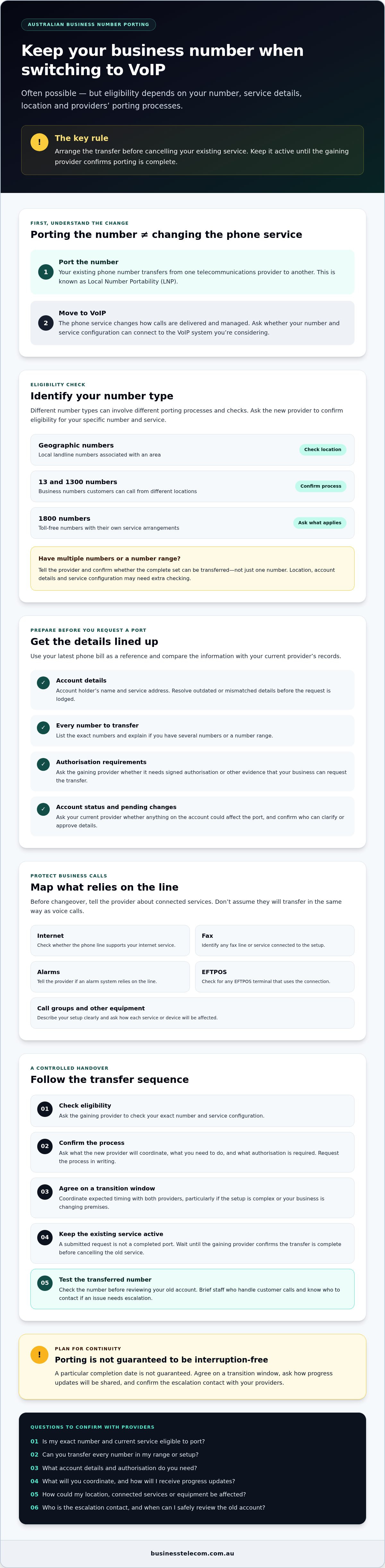
Porting transfers an existing phone number from one telecommunications provider to another. In a typical request, you authorise the new, or gaining, provider to coordinate the transfer with your current provider. The process is known as Local Number Portability (LNP).
Transferring the number is separate from changing the phone service itself. Porting moves the number; switching to VoIP changes how calls are delivered and managed. Before starting, ask the prospective provider to check your exact number and service configuration, and confirm whether it can be connected to the VoIP system you’re considering.
Which Australian business numbers need extra checking?
Start by identifying the kind of number your business uses. Australian business numbers may include:
- Geographic numbers: Local landline numbers associated with an area.
- 13 and 1300 numbers: Business numbers that customers can call from different locations.
- 1800 numbers: Toll-free numbers with their own service arrangements.
These number types can involve different porting processes and checks, so ask the new provider what applies to yours. If your business has multiple numbers or a number range, make that clear when you request an eligibility check. Confirm whether the provider can transfer the complete set, not just one number.
Location and service configuration also matter. For a geographic number, tell both providers if your business is moving premises or changing how the number is used. Ask whether the location, account details or existing service arrangement could affect the request, and what information they need to assess it. A number that looks straightforward may still need extra checks if its account or configuration doesn’t match the provider’s records.
Business Telecom provides business landline and VoIP services in Australia, including for businesses in Sydney, Brisbane and the Gold Coast. If you’re considering a new setup, confirm directly whether your specific number type and current service can be ported.
How to prepare your business number for a VoIP port
A well-prepared request gives both providers clearer information to check and can help avoid preventable delays. Before asking to transfer a business number, assemble the account details and identify any services that rely on the line. The precise documents and authorisation steps can vary, so confirm the process with the gaining provider and check the ACMA’s rules for porting your number.
Check account details before requesting the port
Use your latest phone bill as a reference, then compare the details against the current provider’s records. Check the account holder’s name, service address and every number you want to transfer. Even a small mismatch, such as an outdated business name or address, is worth resolving before the request is lodged.
Ask your current provider whether the account’s status or any pending changes could affect a port. Confirm who will receive updates and who can review or approve information if the providers ask for clarification. The new provider may require a signed authorisation or other evidence that your business can request the transfer. Verify what’s needed before submitting the application.
Coordinate the gaining and losing providers
Ask the gaining provider to confirm number eligibility and explain its porting process in writing. Check what it will coordinate with your existing provider, how it will share progress updates, and whether you need to complete any steps yourself. If your setup includes several numbers, a call group, fax line, alarm system or EFTPOS terminal, describe it clearly and ask how each service will be affected. Don’t assume those services will transfer in the same way as voice calls.
Agree on the expected timing with both providers, especially if your number has a complex configuration or your business is changing premises. Keep the existing service active until the gaining provider confirms the transfer is complete. A submitted request is not the same as a completed port.
Use this sequence: check the number and account details, request the port through the gaining provider, confirm completion and test the new service, then cancel the old service only when the providers’ instructions allow it.
- Check: Match the bill, account holder, service address and numbers; list connected services.
- Request: Provide the details and complete the authorisation steps the gaining provider specifies.
- Confirm: Get an update on completion and test incoming and outgoing calls.
- Cancel: Review the old account and follow provider instructions before ending it.
Businesses in Sydney, Brisbane and the Gold Coast considering a business VoIP setup can discuss number and service requirements with Business Telecom. Confirm whether your specific number and current service can be ported.
How to protect business calls while the number is being ported
A number port isn’t a guaranteed zero-interruption event. Even with the transfer planned, prepare for the possibility that calls may not work as expected during the changeover. If you’re researching how to keep your landline number when switching to VoIP, plan for customer access as well as the number transfer itself.
Agree on a transition window with both providers, then brief staff who answer calls and customer-facing teams who may need to respond to enquiries. Ask the gaining provider what updates it will provide and how to reach the appropriate contact if the transfer doesn’t proceed as planned. The ACMA number porting rules provide official guidance on number transfers, but your providers should confirm the arrangements for your specific service.
Build a simple call-continuity plan
Nominate one staff member to monitor provider updates and share changes with the team. Decide how customers can reach you if the main number is temporarily unavailable, such as through an approved alternative contact method for urgent enquiries. Tell staff what to communicate and who will manage incoming messages.
Call forwarding or a parallel service may be possible, but availability depends on your existing service and provider arrangements. Confirm whether either option can be set up, when it would operate and whether your business needs to take any action. Don’t build your plan around a diversion until the provider has confirmed it.
A written cutover plan gives staff clear contacts, timing and steps to follow if calls are affected. Record the agreed transition window, provider contacts, update method, fallback arrangements and the person responsible for decisions.
Test the new VoIP setup before relying on it
Once the provider confirms the transfer and service setup, test the parts that matter to your business. Include:
- Calls: Place and receive calls, and check that caller ID and the displayed business number are correct.
- Call handling: Test reception, voicemail, extensions and essential routing, including how calls reach the right team.
- Readiness: Check staff devices and internet access, then confirm any fallback steps with your provider.
If a test fails, contact the provider and agree on what needs to be resolved before staff rely on the new setup. Keep the responsible staff member informed, and share the confirmed arrangements with anyone who handles customer calls. That gives your team a practical response plan while you verify the service is working as intended.
What to confirm before choosing a VoIP porting process
Compare providers on how clearly they explain the port and how well the proposed VoIP setup fits your business. Base your comparison on specific answers, not broad assurances. Record each provider’s response so you can check what’s included, what your team must do and who to contact if the request stalls.
Questions to ask a business VoIP provider
Ask for the process and responsibilities in writing, including provider-dependent steps and expected timing. This gives your team a practical basis for planning without treating an estimate as a confirmed completion date.
Check the fit with your business phone setup
Before comparing systems, map how customers and staff use the existing number. Note whether it rings at reception, routes to a team or appears on signage, websites and customer materials. Then confirm how the proposed setup will handle those requirements, including extensions, auto-attendant, voicemail and essential call routing.
Check which devices staff need to use. Ask whether the system supports your required desk phones, computers or mobile calling, and how staff will make and receive calls across office and remote locations. Confirm any equipment or setup requirements with the provider rather than assuming existing devices will work.
These questions help separate the number transfer from the wider decision about how calls should work after the move. For a broader view of the trade-offs between VoIP and traditional landlines, consult the article’s VoIP-versus-landline comparison before settling on a system.
Business Telecom provides business landline, VoIP and cloud phone services in Australia, including for businesses in Sydney, Brisbane and the Gold Coast. Review your business phone requirements and confirm whether your number type and current service can be ported.
Complete the switch and retain control of your business number
A port isn’t complete for your business until the number works as expected on the new VoIP service. Follow the gaining provider’s instructions, get confirmation that the transfer is complete, and test the number and call flows before cancelling the previous service. A transfer confirmation is a useful milestone, but practical checks help catch setup issues that could affect customers or staff.
Verify the number and call flows after the port
Start with a simple external test. Call the business number from a mobile that isn’t part of your phone system and confirm it reaches the correct destination. If your business has different call paths for reception, teams or individual staff, test each essential route rather than assuming it carried across as intended.
- Incoming calls: Check that the number connects and is answered by the right person or team.
- Outgoing calls: Place a call and confirm the expected business number appears as caller ID.
- Call handling: Test voicemail, extensions, reception and any essential routing.
If something doesn’t match the agreed setup, contact your provider promptly and note what happened, including the time of the test and the number or call flow involved. Keep the port completion confirmation and relevant support records with your business phone account. These details make it easier to explain the issue and track the response.
Once the service has passed your checks, review the old account and follow the provider’s instructions for closing it. Check for any remaining services or account matters that need attention, and retain any records your business may need. Don’t cancel the previous service before the new provider confirms the transfer and you’ve verified that your business number works.
Plan the next step with a business phone provider
Before enquiring about a VoIP setup, summarise your current provider, number type, existing service and required call features. Note how staff use the number, including any extensions, voicemail, call routing or remote calling needs. A clear brief helps a provider assess what to check and discuss how the new phone setup could support your business.
Business Telecom provides business VoIP, cloud phone and landline services in Australia, including for businesses in Sydney, Brisbane and the Gold Coast. If you’re planning to keep your landline number while switching to VoIP, you can review your business phone requirements with Business Telecom and confirm whether your specific number and current service can be ported. Eligibility and the steps involved depend on your circumstances, so confirm those details before proceeding.
Plan your VoIP switch with confidence
Keeping your business number when you switch to VoIP is often possible, but confirm eligibility for your specific number and service with the provider. The safest approach is to coordinate the port before cancelling your existing service, agree on how updates and any disruption will be handled, then test the number and call flows before closing the old account.
A clear transition plan helps your team protect customer access while moving to a new phone setup. Gather your account details, outline how calls need to reach staff, and check that the proposed system supports your office and remote calling requirements. That preparation makes it easier to keep your landline number switching to VoIP on track without assuming every transfer follows the same process.
Business Telecom provides business VoIP and cloud phone systems for office and remote calling, as well as business landline services. For businesses in Sydney, Brisbane and the Gold Coast, talk to Business Telecom about your business phone requirements and confirm what to check for your number before proceeding.
Frequently Asked Questions
Can I keep my business landline number when switching to VoIP?
Often, yes, if your number and current service are eligible for porting. Australian businesses may be able to transfer geographic, VoIP, 13, 1300 or 1800 numbers, but the receiving provider needs to check your specific details. If you want to keep your landline number when switching to VoIP, ask about eligibility before arranging the change. Businesses in Sydney, Brisbane and the Gold Coast should confirm their own service arrangements rather than assume every number follows the same process.
Should I cancel my old landline before the VoIP number port is complete?
No. Keep your existing service active until the new provider confirms the port is complete and you’ve tested the number on the VoIP system. Cancelling too early can put the number transfer at risk and may result in losing the number. Follow both providers’ instructions, check that incoming calls reach the right destination, and only then review cancellation of the old service and any other services linked to that account.
How long does it take to port a business landline number to VoIP in Australia?
A simple port of one local number generally takes between 1 and 15 business days, but provider estimates and circumstances vary. Complex ports can take longer, with estimates ranging from 10 to 35 business days up to 6 to 8 weeks. Treat these as indicative timeframes, not a confirmed completion date. Ask the gaining provider for an estimate based on your number type, account details and service configuration.
Can I port my business number if I am changing office locations?
Possibly, but tell both providers about the move before submitting the request. A geographic number, service address or existing configuration may affect the eligibility checks and how calls should be routed after the transfer. Confirm whether the number can be ported alongside your planned location change, what address details are required, and how the VoIP service will direct calls to staff at the new office or working remotely.
What details do I need to port a landline number to VoIP?
Have your latest phone bill, the account holder’s details, service address and exact number or numbers ready. Check that the business name and address match the current provider’s records, and ask the new provider what authorisation it requires, such as a signed Letter of Authorisation. Mention any number range or linked services, including fax or alarms, so the provider can explain whether extra information or separate planning is needed.
Will my business calls stop working during number porting?
They may be affected, so don’t treat a port as a guaranteed zero-interruption changeover. Ask both providers to agree on a transition window and whether forwarding or another temporary call-handling option is available for your service. Availability depends on provider arrangements. Brief staff who answer calls, prepare an approved alternative contact method for urgent enquiries, and test incoming and outgoing calls once the new provider confirms the transfer.
Can I port a 1300 or 1800 number to a business VoIP service?
It may be possible, but confirm eligibility and the required process with the gaining provider before making changes. 1300 and 1800 numbers can have different checks from a local geographic number; typical porting estimates are 3 to 14 business days, though timing varies. Ask how the number will work with your VoIP call routing and keep the existing service active until the provider confirms the transfer is complete.