

The longest feature list doesn’t guarantee a phone system that works when your team needs it. A search for “voip provider australia” often comes down to practical questions: will calls be clear, reach the right people and stay manageable during a changeover or internet disruption?
Cloud phone systems, VoIP services and bundled phone solutions can differ in what they include, who manages each part and how support works when an issue affects daily operations. Call quality also depends on a suitable internet connection, so assess connectivity and continuity as part of the decision, not as an afterthought.
This guide gives you a practical framework for comparing providers against your business requirements. It covers call handling, connection readiness, number porting and changeover planning, ongoing support, scalability and responsibilities. You’ll also see how to assess fit for office and remote teams, including the value of Australian-based support, before choosing a system that can adapt as your operations change.
Key Takeaways
- Separate the roles of your VoIP provider, phone system, internet connection and handsets to see who manages each part of your calling setup.
- Use a practical scorecard to compare essential call features, support, scalability, implementation and commercial transparency against your business needs.
- Assess connectivity at each premises and plan how to handle calls during an internet disruption before moving business calls to the cloud.
- Map call flows, user groups and must-have features to find a voip provider australia businesses can match to their team and locations.
- Consider how call routing, auto-attendants, conferencing and extension management can support everyday workflows for office and remote staff.
What a VoIP provider in Australia should deliver for your business
A business VoIP provider delivers internet-based business calling and the phone-system services that manage how calls reach and move between your people. VoIP is the method of carrying voice calls over an internet connection. A cloud phone system is the hosted platform that organises functions such as extensions, call routing and auto-attendants. The terms are related, but describe different parts of the service.
Clarify responsibilities before choosing a system. The provider supplies and supports the business voice service and phone-system functions. Your internet connection carries the calls, so its suitability affects call quality. Handsets and other devices are how staff make and answer calls, whether they use desk phones, computers or mobile devices. A business-focused provider helps align the setup and call management with your team’s workflows, then assists as you use the service.
For Australian businesses, the connection commonly involves the National Broadband Network (NBN). The NBN provides underlying connectivity, not the business phone system itself. Understanding how these elements fit together makes it easier to identify what needs attention if call quality suffers or your team’s requirements change.
What does a business VoIP provider actually provide?
VoIP converts your voice into data, sends it over the internet and reconstructs it as sound for the person on the other end. The provider delivers the calling service and supporting system, including settings that direct calls to the right person or team. Staff might use a desk phone in the office, a computer or a mobile device. The key is choosing a setup that supports your required call flows, not simply collecting features.
Assess the system against staff mobility, continuity and support needs. For example, consider whether calls need to reach colleagues in different locations and how your team will manage the phone system day to day. Also decide what should happen if the internet connection is disrupted. VoIP relies on that connection, so continuity needs a plan.
Which Australian businesses benefit from business VoIP?
Cloud calling can suit SMEs with office-based, remote or mixed-location teams. Extensions and call routing can direct customer calls to the right person, while conferencing helps colleagues connect across locations. These functions can make everyday call handling more organised without requiring everyone to work at the same desk.
Local support can be relevant for businesses operating across Sydney, Brisbane or the Gold Coast. Business Telecom provides Australian-based customer support and business voice solutions for SMEs, including call routing, auto-attendants, conferencing and extension management. Match these functions to actual workflows, such as how your team answers, transfers and manages incoming calls.
How to compare VoIP providers in Australia: a practical scorecard
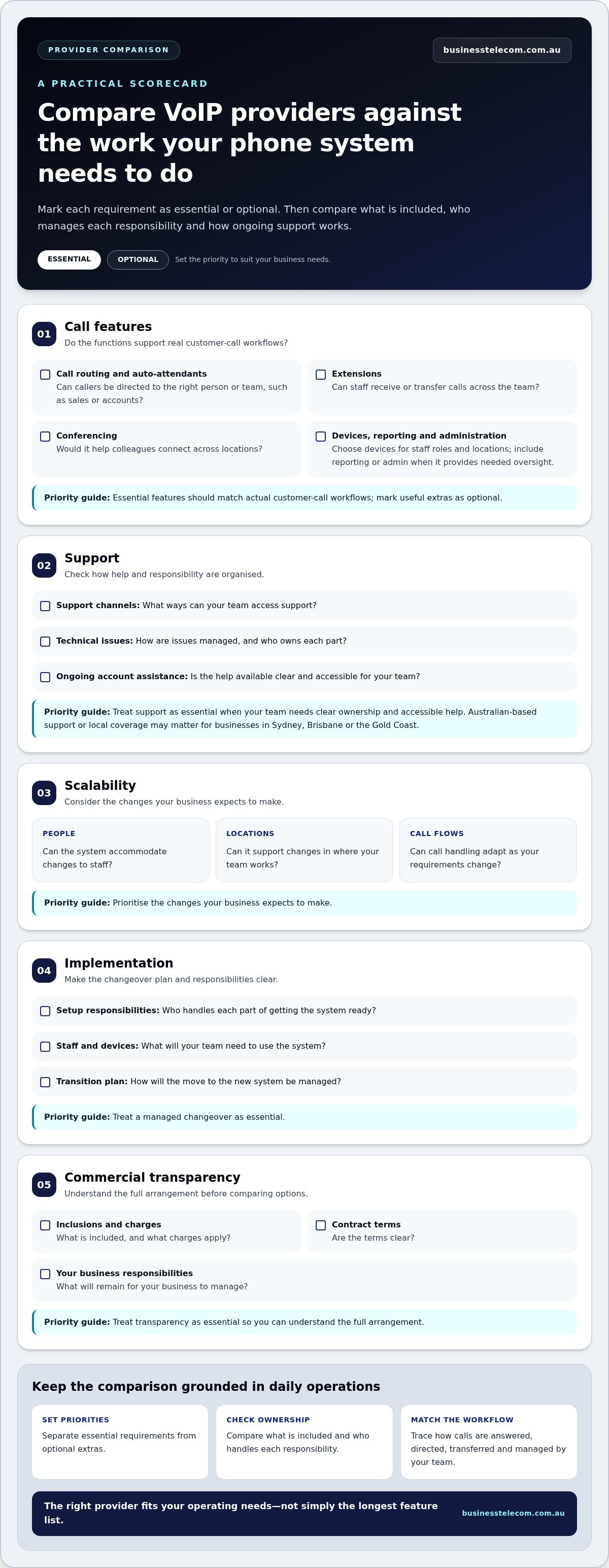
A scorecard keeps the decision focused on daily operations rather than an impressive-sounding feature list. Mark each requirement as essential or optional, then compare what the service includes, who handles each responsibility and how ongoing support works. The right VoIP provider in Australia is the one that fits your operating needs, not the one with the longest feature list.
Which VoIP features should a business assess?
Trace the path a customer’s call takes. An auto-attendant might direct callers to sales or accounts, while extensions let staff receive or transfer calls across a team. Conferencing may help distributed teams; device choice should suit each person’s role and location. Include reporting and administration only if they provide the oversight your business needs. Record which functions are essential and which are useful extras.
How should you compare support and scalability?
Compare how technical issues are handled, how ongoing account support is provided and whether the system can adapt as teams or call flows change. Australian-based support and local coverage may also matter for businesses in Sydney, Brisbane or the Gold Coast. Business Telecom provides Australian-based customer support and business voice solutions for SMEs. For background on consumer information in the sector, see the ACCC telecommunications guidance.
Use your scorecard to identify priorities, then explore Business Telecom’s business VoIP systems against your team’s calling needs.
VoIP reliability in Australia: assess NBN, call continuity and risk
Cloud calling offers flexibility, but relies on suitable connectivity at each premises. An office and a separate branch may have different network conditions, traffic demands and device setups, so assess each site rather than assuming one connection tells the whole story. The National Broadband Network (NBN) is a key part of Australia’s connectivity landscape, but call performance also depends on the business network and service configuration.
What should businesses check about NBN and call quality?
Start with the connection and network setup at each site. Record how many people may be on calls at the same time, what other services use the network, and whether staff rely on Wi-Fi or wired connections. These details help inform a network assessment and phone-system configuration. A speed result alone doesn’t describe every factor affecting a call, and VoIP still depends on an internet connection.
For an SME searching “voip provider australia”, reliability should be part of the service discussion, not an assumption based on a feature list. Document the assessment and any network changes needed before deployment.
How can a business reduce disruption during a VoIP change?
Plan the transition around business hours and the calls customers need to make or receive. Assign responsibility for system setup, staff communication and testing. Include number-porting dependencies and timing in the project plan, without assuming a particular outcome or date.
Agree on fallback call handling before cutover. This could include an alternative contact channel or a documented arrangement for directing calls if the primary connection is unavailable. Test the agreed call flows before switching over, including where calls should go when a staff member is unavailable.
Clear responsibilities matter if an issue remains unresolved. The Telecommunications Industry Ombudsman provides information about dispute resolution in the telecommunications sector. Knowing where to find that guidance is one part of a considered continuity plan.
VoIP provider selection: match the service to your team and locations
Choose a phone system by starting with how your business handles calls, then match its setup and support to the people and places involved. This four-step process turns a broad “voip provider australia” search into a practical assessment of operational fit.
- Map your calls. List your main business numbers, teams, extensions, business hours and common call destinations. Note where callers need reception, a shared team response, conferencing or mobile answering, along with current problems the system should address.
- Define your users. Identify who needs to make and receive calls, where they work, and which devices suit their roles. An office-based receptionist may rely on a desk phone, while remote staff may need to handle calls from a computer or mobile.
- Prioritise features. Separate essential functions from optional extras. Connect call routing, auto-attendants and extension management to specific workflows, such as directing customer enquiries to the right team or helping staff manage calls across sites.
- Assess support. Consider the support approach your business needs and how assistance fits into ongoing account management. For operations across Sydney, Brisbane or the Gold Coast, Australian-based support and relevant local coverage can be useful factors in the decision.
Next, consider how requirements differ by setup. A single office may focus on reception, shared call handling and straightforward administration. A hybrid team needs calling to work across office and remote locations, with devices suited to each person. Businesses across multiple sites may need consistent extensions and routing to help customers reach the right team, while allowing for location-specific call flows.
Plan for change as well as current needs. If staff numbers, work locations or customer-call patterns shift, the system should be manageable as workflows evolve. Business Telecom supports business calling across desktop phones, computers and mobile devices, with features including call routing, auto-attendants, conferencing and extension management. These capabilities can be arranged around the way your team handles calls.
Use your call map and user requirements to focus the discussion on system fit. Explore Business Telecom’s business phone systems for an approach shaped around your team and locations.
Choosing Business Telecom as your Australian VoIP provider
For an SME, a business phone system should support how people handle calls, whether they’re at a desk, working remotely or coordinating across locations. Business Telecom provides business VoIP, cloud phone systems and office phone systems for Australian businesses, with phone-system capabilities and Australian-based customer support aligned with your operational requirements.
What does Business Telecom bring to a business phone setup?
Staff can make and answer calls using desktop phones, computers or mobile devices. An office team can use desk phones while remote staff handle calls from their usual work devices. The right mix depends on each role and how your business wants calls managed.
Features work best when they solve a clear workflow need. Call routing can direct incoming enquiries to the relevant team, while an auto-attendant can guide callers through common options. Extensions help colleagues reach one another and manage transfers; conferencing supports discussions between staff in different locations. Together, these functions can make call handling more consistent for customers and staff.
Business Telecom serves businesses in Sydney, Brisbane and the Gold Coast. For organisations operating in these areas, Australian-based support and local service coverage are useful considerations alongside the phone system itself. Shape the setup around your team’s calling needs rather than adding functions without a practical purpose.
What are the next steps to discuss a business VoIP system?
Bring a clear picture of how your business communicates. Note the main numbers and call flows, who answers each type of enquiry, which staff need extensions, where people work and what devices they use. Include current pain points, such as calls reaching the wrong team or remote staff finding it difficult to stay connected to office calling.
Also identify what may change, such as team structure, work locations or the way customer calls are shared. These details help shape a phone system around current operations and likely needs. If you’re comparing a voip provider australia businesses can work with, focus the conversation on how the proposed setup will support everyday requirements.
Discuss a business phone system with Business Telecom and outline your call flows, users and locations. A clear requirements list is a practical starting point for a system tailored to the way your business operates.
Build a phone system around the way your business works
The right VoIP decision starts with your operations, not a feature list. Map how calls reach your team, identify who needs access and from where, then compare providers on call handling, continuity, implementation and ongoing support. Assess connectivity at each premises and plan alternative call handling before a changeover, so reliability is considered alongside flexibility.
Business Telecom provides business VoIP and cloud phone systems for Australian small and medium-sized businesses, with Australian-based customer support and service coverage in Sydney, Brisbane and the Gold Coast. Phone-system setups can include call routing, auto-attendants, conferencing and extension management to support everyday call flows for office and remote staff.
If you’re looking for a voip provider australia businesses can shape around their teams and locations, start with your call flows, users and priorities. Discuss a business phone system that fits your operations. A clear requirements list is a practical first step towards a system that supports your business today and adapts as it changes.
Frequently Asked Questions
What should I look for in a VoIP provider in Australia?
Look for a provider whose call handling, implementation, support and service responsibilities match your business needs. Compare essential functions such as extensions and call routing against your actual workflows, and make sure inclusions and ongoing assistance are clear. Assess connectivity at each premises and plan for call disruption as part of the decision. For businesses in Sydney, Brisbane and the Gold Coast, local coverage and Australian-based support may also be relevant.
Is VoIP reliable for Australian businesses?
VoIP can support reliable business calling when the internet connection and local network are suitable for the workload. Performance depends on conditions at each premises, including concurrent calls, other network traffic and system configuration. Assess each site rather than relying on a general speed estimate, and plan how calls will be handled if connectivity is interrupted. A suitable setup can support day-to-day operations, but no internet-based phone service is independent of its connection.
Can a business keep its existing phone number when switching to VoIP?
In many cases, a business can transfer an existing number to a VoIP service, but number portability depends on the number and the circumstances of the change. Treat porting as a planned part of the transition, not an automatic step. Include the required details, timing, dependencies and interim call arrangements in your changeover plan. Avoid cancelling an existing service until the porting sequence and cutover arrangements have been coordinated.
How does a cloud phone system differ from a VoIP provider?
A cloud phone system is the hosted platform that manages business calling functions, while the provider supplies the service and supporting assistance. VoIP describes how voice calls travel as data over an internet connection. The terms are connected, but refer to different parts of the setup. When comparing options, clarify what the provider manages, what the phone system includes and what depends on your internet connection and devices.
Does business VoIP work over the NBN?
Yes, business VoIP can operate over an NBN connection if the connection and business network are suitable for the calling workload. Assess each premises, including expected concurrent calls and other network traffic, because performance depends on more than the network name alone. A network assessment can help identify whether the current setup is appropriate and what configuration may be needed before moving business calls to VoIP.
What happens to business calls if the internet goes down?
If the connection supporting VoIP fails, calls using that connection may be interrupted or unavailable. Continuity depends on the phone system’s configured call handling and other available connections or devices. Before cutover, agree on a fallback plan, such as redirecting calls to mobiles where the system and mobile connectivity allow it, or using an alternative customer contact channel. Test the agreed call flow so staff know what to do during an outage.
Is VoIP suitable for a small business with remote staff?
Yes, VoIP can suit a small business with remote staff because calls can be handled on supported desktop phones, computers or mobile devices. A cloud phone system can bring office and remote users into shared call flows, with extensions and routing helping customers reach the right person or team. Consider each worker’s device and internet connection, then choose features that support actual work patterns rather than adding unnecessary complexity.