
A low advertised rate rarely tells the whole story. The business phone line cost Gold Coast businesses pay depends on what a quote counts as a line, how many people need access and what the phone system includes. A phone number, a phone line and a complete system aren’t the same thing, so comparing headline rates alone can leave important costs out of view.
It’s reasonable to want a clear total before choosing a setup. This guide explains the cost components to compare, how per-user and per-line pricing work, and how setup, calling needs and features can affect a quote. It also covers the internet connection behind VoIP and cloud phone systems, so you can assess whether your current service suits business calling in the Gold Coast, Sydney or Brisbane.
You’ll learn how landlines, VoIP and cloud systems differ in practice, and how team size and call patterns can guide your choice. Business Telecom provides tailored phone systems for Gold Coast businesses, with options for office and remote staff and features such as call routing, auto-attendants, conferencing and extension management. The aim is a dependable setup that suits how your team works, without paying for capability you don’t need.
Key Takeaways
- Understand what a phone number, phone line and complete phone system each provide before comparing quotes.
- Assess business phone line cost Gold Coast quotes by separating ongoing service charges, call-plan terms, setup and required hardware.
- Compare fixed voice, VoIP and cloud phone options against your internet connection, call-handling needs and staff flexibility.
- Prepare a consistent checklist of users, extensions, call patterns, essential features and devices to make quote comparisons fair.
- Explore a tailored business landline, VoIP or cloud phone setup that supports the way your Gold Coast team works.
Business phone line cost on the Gold Coast: what are you actually paying for?
A phone number identifies where callers can reach your business. A phone line is the voice service or connection used to make and receive calls, while a phone system manages what happens to those calls. These are related, but they aren’t interchangeable. A quote might cover a number and calling service alone, or a broader setup with call handling, staff access and equipment.
That distinction matters when comparing business phone line cost Gold Coast quotes. The total may reflect more than the voice connection: call-plan terms, the number of users or extensions, call-routing features, setup work and hardware can all affect what’s included. Some businesses need a straightforward way to answer calls; others need calls directed to the right team member or location.
A line rate alone may not represent the total cost of a business phone system. It can exclude the users, features, setup and devices needed to handle calls.
What is the difference between a phone line and a business phone system?
A line supports the call connection. A phone system controls how calls reach people and how staff make outgoing calls. For example, a small Gold Coast office might use a shared business number and extensions so callers can reach different staff members. Another office may need a simpler arrangement. The right scope depends on how the team makes and answers calls.
A cloud system can support staff using desk phones, computers or mobiles, helping connect office and remote calling. It may also bring call routing, auto-attendants, conferencing or extension management into one setup. These are system capabilities, not simply part of having a phone number. Voice over IP (VoIP) carries calls over an internet connection and is commonly used for internet-based business phone services.
Why Gold Coast businesses may need different phone setups
Call patterns vary by industry and operation. A tourism business may handle booking enquiries during set opening hours, while a hospitality venue may need calls directed to the right staff member during busy service periods. Construction workers may spend much of the day away from the office, while a professional services firm may need calls to reach staff working across office and remote locations.
These differences shape what a quote needs to cover. Consider whether calls arrive in concentrated periods or steadily through the day, whether callers need to reach a particular person, and how calls should be handled when the office is closed. Remote work may also affect which devices and extensions staff need. A tailored phone system can match these practical requirements without adding features the team won’t use.
To assess a quote, separate the voice service from the wider system and identify what each component does for your team. Look for clarity on:
- the phone number and calling service being supplied
- the users, extensions and devices covered
- included call-handling features and setup requirements
- how the arrangement supports your opening hours and staff locations
This gives you a clearer basis for judging the full setup, rather than treating the lowest line rate as the whole answer.
Which factors shape business phone line cost on the Gold Coast?
A useful quote separates ongoing service charges from the resources and features your team needs. Business phone line cost Gold Coast businesses are quoted can vary with the calling plan, number of staff, capacity for concurrent calls, setup requirements and required devices. Reviewing each component makes it easier to see what the quote covers and which requirements affect the total.
Recurring charges, calling and user requirements
Recurring service charges may cover access to the phone service, while call-plan terms determine which call types are included and how usage outside the plan is handled. Plans can differ on local, national and mobile calls, so consider where your business calls and whether usage is steady or concentrated at busy times. A plan suited to one call pattern may not suit another.
A phone number identifies where callers can reach you; it doesn’t tell you how many calls can happen at once or how many staff can use the system. Those needs are reflected in call capacity, users and extensions. Before comparing inclusions, map who needs an extension, when simultaneous calls are likely and which team members make or receive the most calls.
Setup, equipment and internet considerations
Setup requirements depend on the chosen system and your existing equipment. Some businesses may be able to use suitable devices they already have, while others may need handsets or configuration for staff extensions and call handling. List setup work and required hardware as separate quote components rather than assuming they’re covered by a recurring service charge.
VoIP carries calls over the internet, so connection performance can affect call quality. Assess the connection at the business premises, including whether it can support voice calls alongside other online work. NBN availability and connection performance can vary by business address, so don’t assume a service used at one location will perform the same at another.
Features also affect the configuration. A business that needs calls directed between teams may require call routing or an auto-attendant, while another may prioritise conferencing or extensions for staff in different locations. Each capability should serve a clear operational need. A tailored setup can help avoid paying for unused functionality while ensuring essential call handling is included.
The fairest comparison uses the same users, call patterns, features, setup scope and hardware requirements across every quote. Use a simple checklist to keep the details consistent:
- Recurring service charge and what it covers
- Included call types and charges for usage outside the plan
- Users, extensions and simultaneous call capacity
- Setup work, required devices and included features
- Internet connection used for VoIP calls
With those details in hand, you can assess whether a proposed business phone system setup reflects your team’s actual requirements, rather than comparing headline rates with different inclusions.
VoIP, fixed line or cloud phone system: how to compare Gold Coast options
Compare each option against the same needs rather than assuming one technology is automatically cheaper or more reliable. A fixed voice service, a VoIP line and a cloud phone system can all support business calls, but they differ in how calls connect, what call handling is available and how staff access the service. Those differences shape the full business phone line cost Gold Coast businesses need to consider.
VoIP describes calls carried over an internet connection. A VoIP line may provide calling through that connection, while a cloud phone system typically adds broader management of users and calls. The terms are related, but the services and inclusions can differ. Compare the actual configuration, not just the label.
| Option | Internet dependency | Call handling | Staff flexibility | Hardware and likely cost components |
|---|---|---|---|---|
| Fixed voice | The voice connection is separate from internet-based calling. | May suit straightforward call handling; assess any additional features required. | Centred on the premises and connected equipment. | Consider service charges, call-plan terms, equipment and setup requirements. |
| VoIP line | Uses an internet connection, so connection performance matters. | Provides internet-based calling; available call features depend on the service. | Can support calling beyond a single office, depending on the setup and devices. | Compare service and usage charges, compatible devices, setup and internet requirements. |
| Cloud phone system | Relies on an internet connection for calling. | Can manage users and features such as call routing, auto-attendants and extensions. | Can support office and remote staff using suitable desk phones, computers or mobiles. | Assess recurring service charges, users, features, setup and required hardware. |
When a business landline may suit your requirements
A business landline may suit a premises that prioritises a fixed voice connection and straightforward call handling. For more context on fixed-voice choices, explore this guide to business landline options. Include the required equipment and call features in your comparison, as a fixed connection alone may not cover how your team needs to manage incoming calls.
When VoIP or a cloud phone system may be a better fit
Internet-based calling can help connect office and remote staff through a shared business setup. As a team grows, call routing, auto-attendants and extensions can direct callers and organise staff access. These features should match real call-handling requirements, and the internet connection must be suitable for voice traffic. A VoIP provider buying guide offers further context for assessing service requirements.
To compare fairly, list staff locations, devices, call-handling features and connection requirements for each option. Then compare what each quote includes, including recurring charges, setup and hardware. Business Telecom provides fixed landline, VoIP and cloud phone system options, with setups tailored to the practical calling needs of Gold Coast teams.
How to assess a Gold Coast phone quote before choosing a plan
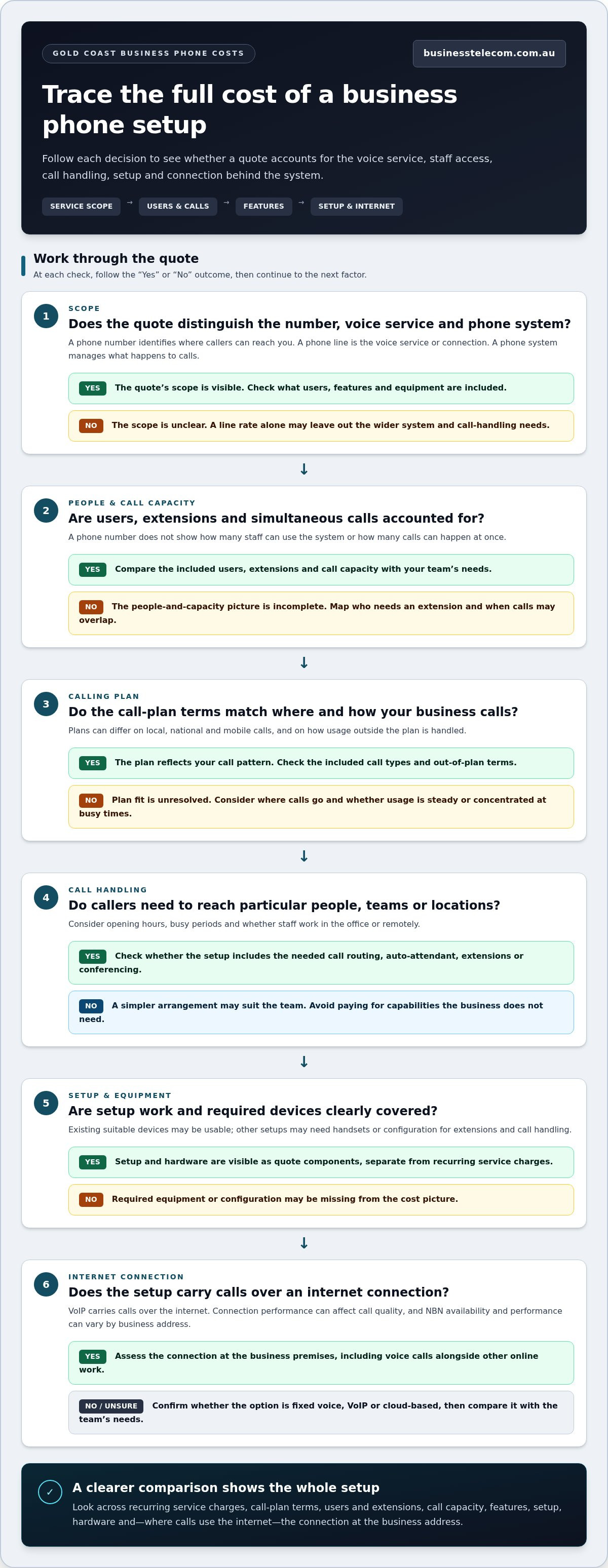
A quote is useful only if it reflects how your business handles calls. Before assessing business phone line cost Gold Coast proposals, prepare one consistent set of requirements and use it for each comparison. This helps reveal differences in scope, from staff access and call features to internet readiness, number continuity and ongoing support.
Work through this checklist before reviewing proposals:
- List users and extensions. Record who needs to make or receive calls, where they work and whether they need an individual extension. Note how many conversations may happen at once, especially during busy periods. This separates staff access from the capacity needed for concurrent calls.
- Describe expected call patterns. Consider when calls arrive, how often staff make outbound calls and whether demand changes during the day or week. Include the types of calls your team handles and periods when several people may be on calls together.
- Separate essential features from optional ones. Note whether your team needs call routing, an auto-attendant, conferencing or other call-handling functions. Mark which capabilities are necessary for daily operations and which would simply be useful, so you can compare proposals on the same basis.
- Identify required devices and work locations. State whether staff need desk phones, computers or mobiles for business calling, and whether they work in the office or remotely. Include equipment you already use as well as any devices the proposed setup would require.
- Assess internet readiness. For VoIP or a cloud phone system, record the business internet connection at each relevant premises and consider whether its performance supports voice calls alongside other work. NBN availability and performance can vary by address, so assess the actual business location.
- Plan for number continuity. List the business numbers callers already use and identify which must remain reachable during a change of service. Include number handling and transition steps in the proposal scope, rather than treating them as separate from the phone setup.
- Document interruption and support arrangements. Decide how calls should be handled if internet or power is interrupted, and compare the continuity approach in each proposal. Review the stated support scope and process, including how technical issues are reported and managed.
- Compare the complete proposal. Check recurring charges, call-plan terms, users, features, setup and hardware against your checklist. Note exclusions or assumptions so a lower headline amount isn’t mistaken for an equivalent overall setup.
This process turns a broad quote into a practical comparison of what your team needs to operate. For a wider view of system types and requirements, compare business phone system options against your checklist.
Business Telecom tailors landline, VoIP and cloud phone setups for Gold Coast organisations, including call handling for office and remote staff. The requirements you’ve mapped out provide a useful basis for choosing a suitable system.
Get a business phone line solution tailored to your Gold Coast team
Once you’ve mapped how calls move through your business, the next step is to choose a phone setup that supports daily work. Business Telecom provides business landlines, VoIP and cloud phone systems for Gold Coast organisations. The right fit depends on where staff work, how callers should reach them and which capabilities your team will use.
Match the phone setup to your team’s call requirements
A business landline can suit an office that mainly needs a fixed voice connection and direct call handling. VoIP provides internet-based business calling, while a cloud phone system can organise calls and extensions across office and remote staff. These options aren’t simply different labels for the same arrangement. Consider what your team needs the system to support, then align the setup with that operating pattern.
For a team that shares responsibility for incoming calls, call routing can direct enquiries to the right people. An auto-attendant can guide callers through available options, while extensions help staff reach one another. Conferencing may suit teams that need to bring participants together by phone. Business Telecom’s phone system setups can include these features, configured around the capabilities your organisation needs.
Think beyond the initial arrangement, too. If staff locations or responsibilities change, consider how the phone setup will accommodate them. A practical configuration should support the way your team works now and provide a clear basis for reviewing future needs, without adding functions simply because they appear on a feature list.
Plan a clear next step for your Gold Coast business
Bring your user numbers, call-handling needs and preferred features into the discussion. Note which staff work remotely, which devices they use and how calls should be managed during disruptions. This gives the conversation a clear operational focus and helps shape a proposal around your business rather than a generic plan.
Price matters, but a headline rate alone won’t show whether a setup suits your team. Consider the full scope alongside ongoing support, including the Australian-based technical support Business Telecom provides. A sound decision accounts for how staff make and receive calls, how callers are directed and what support is available for the phone service.
Business Telecom tailors business landline, VoIP and cloud phone systems to Gold Coast organisations’ requirements. Share your team’s call patterns, work locations and essential features to discuss a suitable setup. Discuss a business phone setup that fits the way your team works.
Plan for the way your business will work next
Give your phone setup a clear owner and a review point. As your team, premises or customer contact patterns change, revisit whether the arrangement still supports the way work gets done. A short record of who relies on the service, which business processes depend on it and what changes should prompt a review can help keep future decisions deliberate rather than reactive.
That forward view gives business phone line cost Gold Coast a practical context. The right setup should meet your operation’s current needs and give you a sensible basis for reassessing them as the business develops. A change in team responsibilities, work locations or customer call patterns may be a useful prompt to review the arrangement, rather than waiting until the setup feels restrictive.
Business Telecom helps Gold Coast businesses shape phone solutions around their operational requirements. Bring the needs you’ve identified and the changes you’re planning into a focused discussion. Discuss a business phone setup for your Gold Coast team.
Frequently Asked Questions
What does business phone line cost on the Gold Coast depend on?
The total depends on the service configuration and how your business uses it. For a Gold Coast practice with several staff answering one main number, call capacity and routing needs may differ from those of a sole operator who handles calls directly. The business phone line cost Gold Coast quote should reflect your actual call patterns, devices and features, not just the number itself. Compare proposals against the same requirements to see what each includes.
Is a business phone line the same as a business phone system?
No. A phone line or number gives your business a way to make and receive calls, while a phone system manages how calls are handled across the team. For example, a caller could reach a receptionist first, then be transferred to a particular staff member. A quote may cover the calling service, the system or both. Check the scope to understand what is included and how it fits your day-to-day call handling.
Can my Gold Coast business use VoIP over NBN?
Yes, if the business internet connection is suitable for your calling requirements. Before choosing VoIP, consider how many people may be on calls at once and whether calls will share the connection with video meetings, file transfers or other online work. NBN access and performance can differ between Gold Coast business addresses. Assess the connection at the premises where calls will take place, rather than relying on performance at another location.
Can I keep my existing business phone number when changing providers?
Number portability may let you retain an existing business number when changing phone services, depending on the number and transfer process. Start planning early: note the numbers customers use, decide who will manage the changeover and prepare customer notices if call arrangements change. Don’t cancel the current service before the transfer process is arranged, as doing so may complicate the move. Include number continuity in the transition plan, not just the new system quote.
How many simultaneous calls can one business phone line handle?
Concurrent call capacity depends on the service configuration, so one business number doesn’t necessarily limit the business to one call at a time. Consider a busy period when several customers call while staff are also making outbound calls. Decide whether callers should wait, be routed to another staff member or reach different teams. Sharing these patterns helps define the capacity and call handling the proposed setup needs to support.
Does every staff member need a separate business phone line?
No. Staff may use extensions within a shared phone system while the business presents a main number to customers. A direct number may still make sense for a team member who handles their own client calls, such as an account manager. Map who needs to be reachable directly and who can share call handling. This helps distinguish the number of services required from the number of people who need access.
What happens to business calls if the internet goes down?
An internet outage can affect VoIP calls, so decide in advance how your business should respond. For example, you may need a plan for customers trying to reach a busy Gold Coast premises, including who will monitor enquiries and how staff can respond through an alternative arrangement. The suitable approach depends on the phone setup and operational needs. Include interruption handling in the system design and document staff responsibilities.