

A Sydney-wide label does not tell you whether a provider serves your suburb. To find local business phone experts in Sydney, search using your suburb and compare the locations named in business listings with those described on service pages. A broad Sydney label alone may not show whether the provider covers your part of the city.
That distinction matters when choosing a phone system specialist for your business. Clear, consistent location information helps you narrow your options and understand the provider’s stated coverage before taking the next step.
Use local searches and listings to identify relevant specialists, assess the suburbs they name and understand their service-area information. Then compare business phone system options against your workplace and calling needs, focusing on providers whose coverage and services fit.
Key Takeaways
- Include your suburb in local searches, then compare the locations named in business listings with the provider’s service-area information.
- Look for phone system specialists whose business focus and stated coverage match your location and requirements.
- Compare providers by the phone system features relevant to your call needs, and read reviews for useful details about customer experience.
- Consider your internet connection and how your team uses it when assessing whether business VoIP could suit your Sydney workplace.
“Near me” and “where to buy” searches
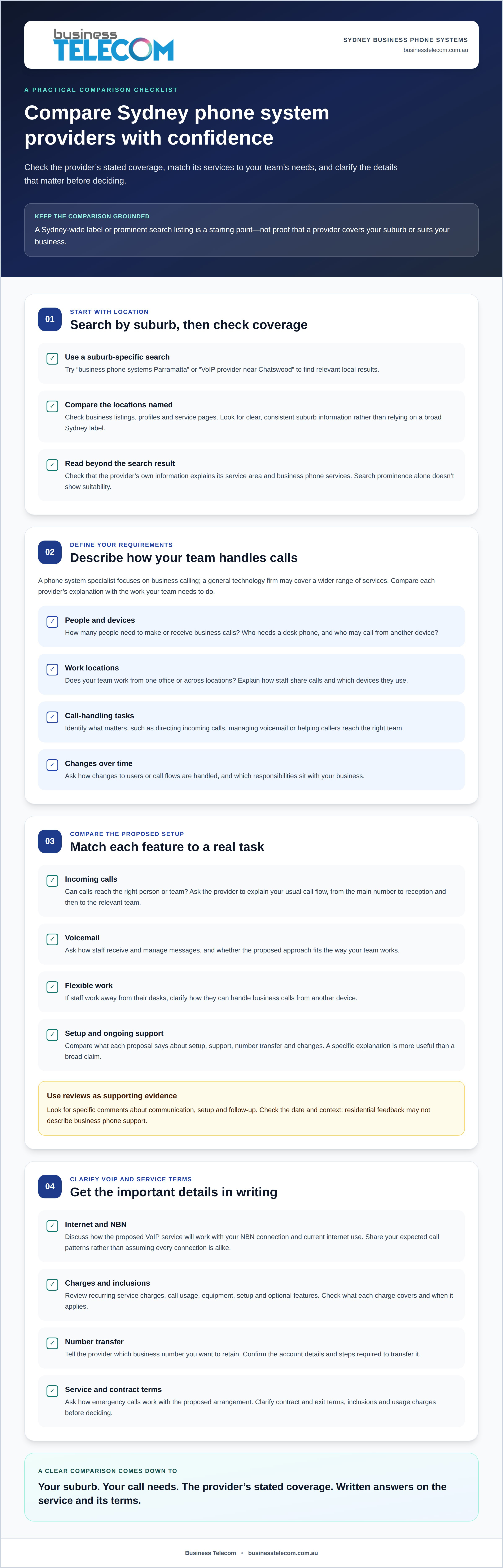
Suburb-specific searches can help you find phone system specialists and see which locations they name. Compare details across Google results, business profiles and service pages rather than treating a Sydney-wide listing as proof of coverage.
Sydney provider searches and competition
Try searches such as “business phone systems Parramatta” or “VoIP provider near Chatswood”. Then compare the locations in each result with the provider’s own service information. Sydney businesses compete for visibility in local search results, so a prominent listing is a useful starting point, not a measure of suitability.
Check whether the website and directories use consistent suburb names and clearly describe the business phone services. A search result such as “office phone systems Parramatta” is more useful when the page explains its service area and the business needs it addresses. Specific, consistent details matter more than broad SEO claims.
Sydney specialists and VoIP requirements
Phone system specialists focus on business calling, while general technology firms may cover a wider range of services. Compare descriptions with your needs, such as replacing an office setup or managing calls for a team working across locations. A listing may identify a provider, but its service information should explain what it does.
For VoIP, consider how the proposed service will work with your NBN connection and current internet use. Discuss your expected call patterns and the details needed to assess a suitable setup. This keeps the conversation focused on your workplace rather than assuming every connection or system is alike.
Service terms and emergency calls: Ask the provider to explain the service terms, number-transfer process and how emergency calls work with the proposed arrangement. Get these details in writing before deciding.
Plan charges: Review recurring service charges, call usage, equipment, setup and optional features. Check what each charge covers and when it applies.
Keeping your number: Tell the provider which business number you want to retain. Confirm the account details and steps required for number transfer.
Before signing: Clarify inclusions, usage charges, contract and exit terms, number transfer and emergency calling. Written answers make the offer easier to assess.
Which Sydney businesses specialise in phone systems and business telecommunications?
Sydney businesses offering phone system expertise generally include telecommunications providers, phone-system integrators and IT firms with telephony services. Their roles can differ: one may supply business calling services, while another configures office communications around a team’s call needs.
Look for a provider focused on business communications, rather than a general technology company that only briefly mentions phone systems. A specialist should be able to explain how a proposed setup handles incoming calls, staff extensions and changes as your business grows.
Match the system to your workplace. A professional practice with a reception team may need calls directed to the right staff, while a small office may prioritise straightforward call handling. These examples help you explain the operational need without prescribing a particular system.
Before comparing proposals, prepare a short requirements list:
- How many people need to make or receive business calls?
- Which staff need desk phones, and who may call from another device?
- Does the team work from one office or across locations?
- Which call-handling tasks matter, such as directing calls or managing voicemail?
Explain how many people will use the system, how they share calls and which devices they need. For example, a business where several employees share reception duties may have different requirements from a team where each person handles calls independently. If your team relies on mobile devices or laptops for softphone apps, hardware maintenance services such as My Cellphone Repairs can also help keep handsets and MacBooks operational.
Ask for a plain-language explanation of the proposed system, how staff will use it and what changes involve. Each recommended capability should connect to a specific task, such as helping callers reach the right team.
Consider how the provider will support your business after setup. Clarify how service questions, changes to users and call flows are handled, and which responsibilities sit with your business. Clear answers make proposals easier to compare.
How do the top Sydney business phone providers compare on features and customer reviews?
Compare providers against the same business needs, not just their feature lists. A Sydney team handling reception calls may value call routing, while a business with remote staff may prioritise flexible calling. Match each capability to a task your employees need to complete.
Review each proposal’s details about setup, ongoing support, number transfer and contract terms. Ask how the system handles your usual call flow, such as directing a customer from the main number to reception and then to the right team. A specific explanation is more useful than a broad claim.
- Call handling: Can incoming calls reach the right person or team?
- Voicemail: How do staff receive and manage messages?
- Flexible work: How can employees handle calls away from their desks?
- Changes: What happens when your team or call flow changes?
Use customer reviews as supporting evidence, not a complete measure of service quality. Look for specific comments about communication, setup and follow-up. Repeated details can be more informative than a short general compliment.
Check review dates and context. A comment about residential service may not describe business phone support, while one about an office installation may be more relevant. Consider whether the provider responds constructively to feedback and addresses the issue raised.
Compare like with like: note which capabilities are included, which require separate arrangements and how support is described. Weigh these details against your call needs and team structure. A small office with shared reception duties, for example, may value simple call management over a feature it will not use.
What are the NBN and internet requirements for business VoIP in Sydney?
Business VoIP carries calls over an internet connection, so the connection needs to suit how your workplace uses phones. A plan name or advertised speed alone does not describe your team’s calling patterns or other online activity.
Start with how your staff work. A Sydney office might handle incoming customer calls while employees use video meetings, cloud software and file-sharing tools. Consider these demands together rather than assessing voice calls in isolation.
To discuss whether a connection suits your proposed setup, a specialist can consider:
- How many employees may make calls at the same time.
- Which online tools staff use during busy calling periods.
- Whether employees work from the office, home or multiple locations.
- What internet service and network equipment the business currently uses.
These details keep the discussion focused on actual workplace use. Call requirements may differ, for example, between a reception desk handling customer enquiries and staff who make occasional calls while using other business applications.
Connection arrangements can vary between workplaces and remote staff. Discuss the internet services and devices involved, then clarify what the proposed VoIP arrangement requires. This gives your business a clearer basis for deciding whether to proceed or address connection needs first.
Before making a change, clarify how the system will be used, what information is needed and how the internet connection fits the proposed setup. Focus on your staff’s calling patterns and daily work rather than relying on a generic speed figure.
To discuss an internet-based phone setup for your Sydney business, talk through business VoIP options.
Business Telecom
Business Telecom helps Sydney businesses consider phone system options against their team’s call needs, workplace setup and internet requirements. If you’re comparing phone system options in Sydney, start by defining how staff handle calls and what needs to change.
Share priorities such as directing incoming calls, supporting staff across locations or updating existing equipment. Discussing these requirements with Business Telecom can help you identify options suited to your workplace.
Contact Business Telecom to discuss your Sydney business phone requirements.
Plan your next phone system step
Choosing local business phone experts in Sydney helps turn research into a clear picture of what your team needs. Start with the calls your business handles, how staff work and the changes you expect. This gives the discussion a practical purpose and keeps the system aligned with daily operations.
Business Telecom serves businesses in New South Wales and Queensland. If you’re planning an upgrade or reviewing how your team manages calls, discuss your requirements and the options that may suit your workplace.
Contact Business Telecom today to talk through your Sydney business phone requirements. A considered next step can help you make a more confident decision for your team.
Frequently Asked Questions
What areas do you cover?
Business Telecom serves businesses in Sydney, Brisbane and the Gold Coast. If your business operates across more than one of these cities, consider how staff need to use the phone system at each site. Set out the requirements for every workplace rather than assuming that all locations need the same arrangement.
What business phone services do Sydney phone experts offer?
Ask Business Telecom which business phone services are currently available for your requirements. When comparing options, consider the type of system your business needs, how staff will use it and whether it suits your operations.
Which Sydney providers offer VoIP, cloud PBX, hosted phone systems, and desk phones?
Ask providers whether they currently offer business VoIP or cloud phone systems, and which devices their platforms support. When comparing a setup, identify which devices staff need to use and confirm that they fit your work locations and calling needs.
How do you choose a reliable business phone expert in Sydney and check their credentials?
Compare the provider’s business phone services with your organisation’s needs, then review any published qualifications and accreditations. Treat customer reviews as feedback, not proof of a formal credential. A useful proposal clearly describes the system, its scope and responsibilities, so you can decide based on documented information rather than broad marketing claims.
Which phone experts serve specific Sydney areas and offer local installation or support?
Check which providers serve your area and what phone system services they currently offer. Service-area coverage does not by itself mean a technician will attend your premises; local installation and support arrangements are separate details. For a multi-site organisation, document each workplace’s requirements and include the expected delivery and support arrangements in the agreed service scope.
What are common risks and hidden fees in Sydney business phone plans?
Review recurring service charges, call usage, equipment, setup costs and optional features, and ask what each charge covers and when it applies. Clarify inclusions, contract and exit terms, number-transfer steps and emergency calling in writing before deciding.