
The lowest monthly plan isn’t always the best-value business phone option. To compare business phone providers in Australia, look beyond the advertised rate: the right fit depends on your team size, call-handling needs and the features your business will actually use.
It’s reasonable to start with price, but a fair comparison also considers the full plan cost, paid add-ons and how users and handsets are counted. A setup that works for a small team may not suit a growing office or staff who take calls away from their desks. Call capacity, number requirements and support arrangements also affect how well an option fits your business.
This guide explains how to assess providers by business size, plan pricing, total cost, VoIP features and optional extras. Compare phone-system options against your day-to-day call needs, plan terms and inclusions rather than choosing on headline price alone. Use these criteria to build a practical shortlist for your Australian business, whether you’re reviewing an existing setup or planning a change.
Key Takeaways
- Match the plan structure to your team’s users, handsets and call capacity, rather than choosing by business size alone.
- Compare the full cost of each option, including equipment, setup, contract terms and paid extras.
- Prioritise VoIP features that support how your team handles calls, and avoid paying for add-ons that won’t be used.
- Use a consistent set of criteria to weigh plan flexibility, service arrangements and fit for your business before deciding.
Business phone systems for different company sizes
A VoIP phone system needs an internet connection with capacity for simultaneous calls and other business traffic. The required speed depends on how your office uses its connection. Staff can connect compatible IP phones or headsets, while a wired network connection can support desk phones.
Match the setup to how employees handle calls, not just your headcount. A business with 3-20 users may need fewer physical handsets if staff share desks or take calls on mobile devices. A reception team with several incoming calls may need more call capacity than a similar-sized team that mainly makes outgoing calls. Identify who answers calls, where they work and when calls overlap.
| Business setup | Users and equipment | Call handling to compare | Contract consideration |
|---|---|---|---|
| Owner-operated business | One main user; mobile or desk phone | Direct calls and voicemail | Flexibility if staffing changes |
| Small office team | Several users; shared or individual handsets | Call transfers and shared coverage | How extra users are added |
| Growing or multi-site team | Users across offices or working remotely | Consistent call routing between locations | Capacity to adapt as teams change |
Use the table to narrow your options, then map out a typical workday. A clinic, for example, may need reception to transfer calls to practitioners, while a mobile service team may need calls directed to staff away from the office. Focus on the operational need rather than assigning a handset to every employee.
Privacy also belongs in the comparison. The Privacy Act 1988 is relevant to Australian business phone data and privacy compliance, according to the Federal Register of Legislation. Consider how call records, recordings and customer details are handled before choosing features that collect or store information.
Choose a system that matches your call patterns, equipment needs and contract preferences instead of paying for capacity you don’t expect to use.
Cloud phone system pricing and total cost of ownership
Compare cloud phone systems by their full billing structure, not just the subscription label. Ask the provider how its quote process works. Key cost drivers include user numbers, equipment, setup, included calling and optional features.
First identify how the provider bills: per user, per line or through a bundled plan. A five-person Australian business that rarely needs more than two simultaneous calls could find per-line VoIP pricing cheaper than per-user pricing. The right model depends on overlapping calls, not employee count alone.
Then assess what the recurring charge includes. Check whether calling allowances have a fair-use threshold, and how additional usage is handled. If a plan specifies a threshold of 3,000 minutes per user per month, compare that limit with your team’s actual calling pattern.
- Subscription: Identify whether billing follows users, lines or a bundle, and how changes affect charges.
- Equipment: Account for desk phones, headsets or other devices required for your chosen setup.
- Setup: Include configuration and any number-transfer or installation charges in your comparison.
- Add-ons: Separate optional features from the core plan to see their ongoing effect.
- Contract: Review the minimum term and the exit-fee method, which can involve remaining monthly fees or a declining charge.
Internet capacity is another ownership factor. Voice calls share the connection with video meetings, cloud applications and file transfers, so busy periods can affect call quality. Include network changes in your planning if the existing connection is already heavily used.
For a national business with several locations, include the cost and call-routing implications of its number strategy. Build a like-for-like comparison that separates recurring charges, one-off costs and optional extras. To explore cloud phone system options, consider how the setup aligns with your users, equipment and call volumes.
Comparing VoIP features and paid add-ons
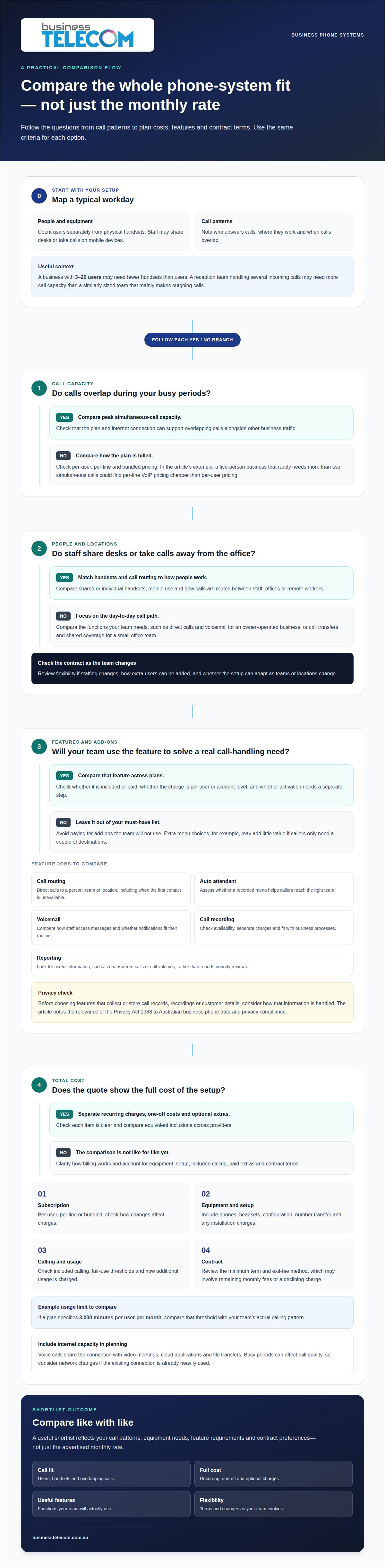
Compare features by the job each one does, then decide whether it solves a real call-handling problem. A two-option IVR menu, for example, can direct callers to sales or accounts instead of relying on reception to transfer every enquiry. Extra menu choices add little value if callers only need those two destinations.
Group features into practical categories: call routing, caller choices, message handling and reporting. For each one, identify who uses it, when they need it and what happens without it. A small team might value voicemail sent to email, while a busy office may prioritise transferring calls between staff.
- Call routing: Check how incoming calls reach a person, team or location, including when the first contact is unavailable.
- Auto attendant: Assess whether a recorded menu helps callers reach the right team without receptionist intervention.
- Voicemail: Compare how staff access messages and whether notifications fit their work routine.
- Call recording: Establish whether recording is available, separately charged and appropriate for your business processes.
- Reporting: Look for useful information, such as unanswered calls or call volumes, rather than dashboards nobody reviews.
Separate included features from paid add-ons. A plan with a lower headline charge can cost more once you add essential functions. Compare the same feature set across options, noting any per-user or account-level charge and whether activation requires a separate step.
Consider how each feature would work in your team’s daily routine. A mobile app may help staff answer business calls away from their desks, but only if they’ll use it and the connection supports clear conversations. Call recording may suit quality reviews, while also creating extra handling considerations for recorded calls.
Rank each feature as essential, useful or unnecessary. Choose a plan that covers essential call-handling tasks without paid add-ons that don’t serve a clear business need.
Australian business phone provider comparison
To compare business phone providers in Australia, assess service type, call quality, coverage and contract terms together. Business VoIP, hosted PBX and traditional landlines differ in how calls are carried, managed and answered.
Hosted PBX
Hosted PBX delivers business phone-system functions through a platform managed by a provider, rather than equipment housed at your premises. Staff connect using compatible handsets or other supported devices, and calls can be managed across locations. Compared with traditional landlines, hosted PBX supports internet-based call management. When you compare business phone providers in Australia, consider how each service handles extensions, transfers and changes to your team.
Traditional landlines
A traditional landline carries calls over a fixed-line service to a physical handset. It may suit a business that relies on desk phones and prefers a familiar setup, but it doesn’t offer the same internet-based flexibility as VoIP. Compare line arrangements, equipment needs and number-transfer processes. Telstra is one Australian telecommunications name, but the provider alone doesn’t determine whether a service suits your business or location.
Provider quality and service terms
No provider offers the best call quality and network coverage for every Australian business. Results depend on service type, your connection, network conditions and handset. Compare fault terms as well: a 4-hour resolution target differs from a 48-hour target.
Contract terms define the commitment and any early exit charges. Providers may use a fixed fee, a declining fee or remaining monthly charges. Australian geographic number ports generally take 8-15 business days. Under the stated figures, 80% complete within 8 business days and 98% within 15 business days. Keep your existing service active until porting is complete, as cancellation ends your right to port that number.
Prioritise coverage where your team works, call quality, contract flexibility and number continuity. Then compare VoIP, hosted PBX and landline options against the same requirements.
Business Telecom: VoIP phone system considerations
A VoIP phone system may suit your call-handling needs, team structure and equipment. If you’re replacing desk phones or routing calls between office-based and remote staff, the right setup depends on how your people work and which calls need managing.
When reviewing business phone systems, consider how your team handles calls and what equipment it uses. The right option depends on your business’s requirements.
When comparing providers, bring your user and handset requirements, call patterns and preferred features into the discussion. Contact Business Telecom to discuss your business phone system requirements.
Move from comparison to a practical next step
Before committing, turn your shortlist into a change plan. Decide who will make the final decision, coordinate the transition and communicate changes to staff. To compare business phone providers in Australia effectively, base the decision on your organisation’s priorities, not just the preferences of the person managing the purchase. Set a realistic timeframe so everyone affected has time to understand what will change.
Agree on how you’ll assess the new arrangement once it’s in place. Ask the team to note call-handling issues, confusing processes or adjustments that would make daily use easier. A simple feedback process gives you a practical way to review the setup and address friction early. Keep the decision criteria and responsibilities together so everyone knows what success looks like.
When you’re ready to discuss the requirements for your business, contact Business Telecom to talk through your needs. A considered transition plan can help your team approach the change with clarity.
Frequently Asked Questions
How do I choose a business phone plan provider?
Choose a provider whose service terms, account management and support arrangements suit your business. Ask who handles faults, how account changes are managed and what appears on invoices. A business with several people authorised to manage its phone service, for example, may value clear account controls. Record your requirements before reviewing proposals so you can assess practical administration as well as the advertised plan.
What types of business phone plans are available?
Business phone plans can cover fixed-location voice, internet-based calling, mobile services or a combination. A business with desk-based reception staff and employees travelling between sites may need different arrangements for each group. Before choosing a plan, list which roles need a fixed business number, which need mobile calling and whether calls must reach staff across locations.
Are users concerned about access to emergency services?
Yes. CHOICE’s survey found that 49% of surveyed Australian mobile users were concerned about being unable to contact emergency services. Australian carriage service providers supplying an emergency telephone service must provide access to 000. For your workplace, make sure staff know how to contact emergency services from the phones they use, including any workplace procedure for an urgent situation.
Do I need a 1300 number, or can I use a local number?
A local number can suit a business whose customers identify with its area. A 1300 number can support a national presence, while an 1800 number lets customers make completely free inbound calls. For example, a business running a national campaign may consider whether an 1800 number better suits its customer offer. Choose a number that fits your audience and how you present your business.
How much should a business phone plan cost per month?
There’s no single monthly amount for every business phone plan. Before comparing totals, establish whether quoted charges include GST and whether billing is monthly or tied to a longer commitment. Ask for recurring and one-off charges to be shown separately. This makes it easier to compare payment schedules and avoid treating a monthly figure as the whole cost.
Is VoIP reliable enough for a small business in Australia?
VoIP can support small-business calling when configured around how staff work. Assess the experience in each relevant setting, such as reception, a meeting room and a remote employee’s workspace. Before relying on the setup for routine customer calls, test internal and external calls, transfers between users and audio clarity at each location.