

To work out how to reduce your business phone bill in Sydney, compare what you pay with the services your staff actually use. Check whether each plan fits your team’s calling needs, whether support meets your operational requirements and whether your phone setup is still fit for purpose. This gives you a clear basis for deciding what to change, rather than reacting to the headline charge alone.
This guide takes you through a practical review, from assessing plan suitability to checking account management and identifying services you may no longer need. It also explains how to compare a legacy phone system with cloud options, so you can weigh any change against your business’s needs. You’ll have a framework for deciding what to keep, remove or investigate, without assuming the cheapest plan is automatically the right fit.
Key Takeaways
- Match your plan to how staff actually make and receive calls, not just the allowances on the bill.
- Assess whether your provider’s support and account management suit the way your business operates.
- Review each line and call allowance to spot services your team no longer needs.
- Compare your current phone system with cloud options, weighing costs against how your team handles calls.
1. Comparing call plans with actual call volumes and patterns
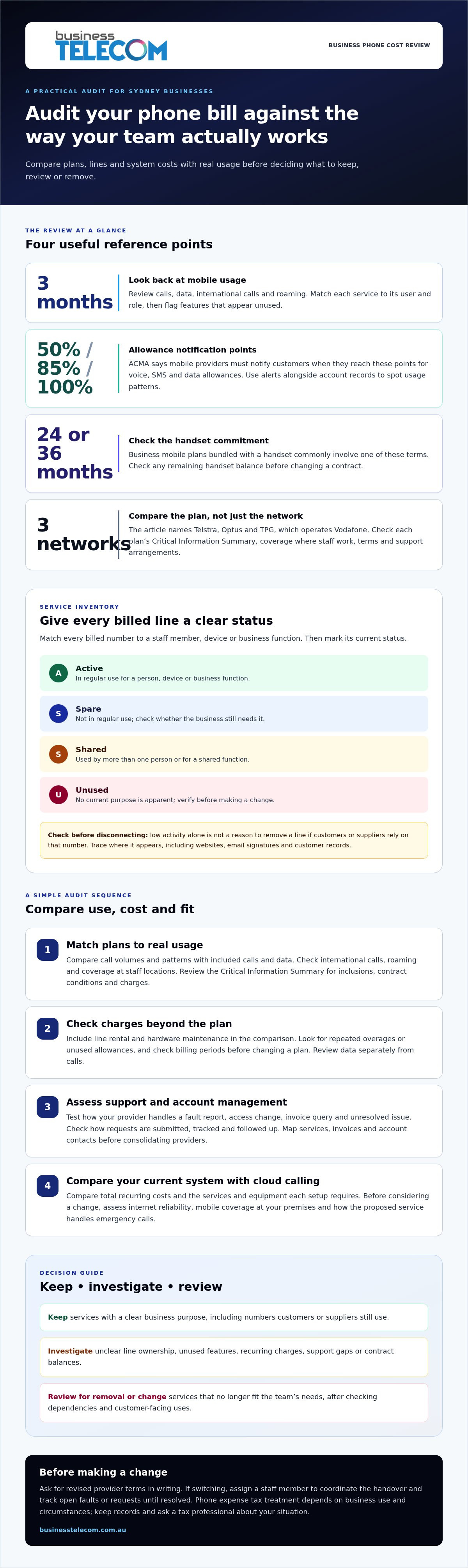
Compare each plan with your team’s actual use, not just its headline allowance. Review mobile usage over the previous three months, including calls, data, international calls and roaming. Match each service to its user and role, then flag features that appear unused. Include line rental and hardware maintenance in the comparison, as recurring charges can remain even when a service contributes little to daily work.
Telstra, Optus and TPG, which operates Vodafone, are Australia’s three mobile networks. Compare business plans by checking the Critical Information Summary for inclusions, contract conditions and charges. Australian Communications and Media Authority guidance requires providers to publish a summary for each plan. Assess coverage where staff work as well as the plan terms.
Compare month-to-month plans with handset bundles by weighing flexibility against the device arrangement. Business mobile plans bundled with a handset commonly involve a 24- or 36-month term. Month-to-month plans let you change services as staffing needs shift, while buying handsets outright can keep plan choices more flexible. Check any remaining handset balance before changing a contract.
Compare international roaming and call charges with staff travel and overseas calling needs. Then compare your current system’s total recurring costs with a cloud phone option, including the services and equipment each setup requires. The tax treatment of phone expenses depends on their business use and circumstances. Keep invoices and records that distinguish business use from private use, and have a tax professional consider the treatment for your business.
Treat the audit as a comparison between what each call plan provides and the call volume and patterns the business actually records. The previous three months of mobile usage can also help Australian businesses assess staff data needs, rather than relying on a general estimate. As teams change, month-to-month plans allow businesses to add, drop or change services to keep arrangements aligned with current staffing. Reviewing charges at the same time can reveal line rental and hardware maintenance fees that may be eliminated, helping distinguish useful services from costs that no longer fit the business’s needs.
2. Considering provider support and account management
Before switching, assess internet reliability, mobile coverage at your Sydney premises and emergency-calling arrangements. Cloud calling relies on internet access, so an outage could affect calls using that connection. Check mobile reception where staff may need a backup, and clarify how the proposed service handles emergency calls.
Assess support by using real tasks your team handles: reporting a fault, updating an employee’s access, querying an invoice or escalating an unresolved issue. Check how staff submit requests, track progress and identify who is responsible for follow-up. A clear account process can reduce time spent chasing answers and help staff get back to work.
Some smaller providers use a major telco network, but network access alone does not mean their plans or support are identical. Compare coverage at your business sites, account tools and service-issue process. For example, if a mobile plan uses Telstra’s network, assess that provider’s specific terms and support arrangements rather than assuming they match Telstra’s retail service.
Consolidating providers can simplify administration by reducing separate invoices and account contacts. Map which services each provider handles, who approves changes and where invoices should go. Before combining accounts, compare service terms and support pathways. A single invoice is useful only if your team can still identify each service and resolve issues efficiently.
When negotiating with your current provider, explain the account changes you need and ask for revised terms in writing. If switching, assign one staff member to coordinate the handover and track open faults or requests until they’re resolved. For unresolved Australian service-provider disputes, contact the Telecommunications Industry Ombudsman on 1800 062 058. If you’re reviewing phone-system options alongside support needs, explore business phone system options.
3. Finding excess lines and minutes
Start with a service inventory, matching every billed number to a staff member, device or business function. Mark each line as active, spare, shared or unused, then ask its owner whether it still supports a regular task. A former employee’s mobile, an old fax line or a rarely used conference number can stay on an invoice after its purpose has changed.
Next, compare line and call records with the way your team works. Check whether several staff have separate lines despite sharing a reception desk, or whether a rarely used number still receives essential customer calls. Review call volumes by number and time period. Low activity alone is not enough reason to disconnect a line if customers or suppliers rely on it.
For each active service, compare included minutes with actual usage and identify repeated overages or unused allowances. Australian mobile providers must notify customers when they reach 50%, 85% and 100% of their voice, SMS and data allowance, according to the Australian Communications and Media Authority (ACMA). Use those alerts with account records to spot patterns before paying for an allowance the team doesn’t need.
Check data separately from calls. A staff member who uses office internet for most work may need a different mobile data allowance from someone who regularly works away from the office. Review provider usage records alongside billing periods, so one busy day does not drive a permanent plan change.
Before removing a number, trace where it appears, including websites, email signatures, customer records and printed material. Assign an owner to each retained line and record its purpose in the inventory. This check helps avoid paying for dormant services while keeping the numbers customers still use. Revisit the inventory when roles change or a service is replaced.
Australian mobile customers can reduce the risk of excess data charges by tracking usage through their provider’s app or website and reviewing bills regularly.
4. Replacing legacy phone systems with cloud phone systems
A legacy office phone system can carry ongoing line rental, maintenance and hardware charges, even when staff use only some lines. A cloud phone system shifts call handling to an internet-based service and can reduce reliance on on-site equipment. Compare the full monthly cost, including subscriptions, connectivity, handsets, support and any remaining contract charges.
Can a Sydney business save money by switching from landlines to VoIP or Teams Phone? It may, if the replacement’s total cost is lower than the current charges for lines, equipment and maintenance. VoIP carries calls over an internet connection. Teams Phone is another option to assess against your business’s calling needs and required subscriptions.
Build a like-for-like comparison before deciding. List the users, numbers, handsets, call-routing needs and existing features your team relies on. Then compare those requirements with each option’s monthly charges, setup needs and contract terms. Include any excess capacity in the current system, but do not remove a feature simply because usage records show it is used rarely.
Check whether your internet connection can support planned calls, especially when staff share it with video meetings and other work. For example, a small Sydney office moving calls from desk phones to laptops should consider how staff will make and receive calls at their desks and away from the office. Test the proposed call flow with staff before retiring existing lines or equipment.
Plan the change around number transfers, staff instructions and a clear cutover date. Keep a record of current numbers, call flows and essential settings so the new system can be configured to match business needs. Review the first invoices against the comparison to catch duplicate services or unexpected charges. To discuss a cloud phone system for your requirements, talk through your phone system options.
Business Telecom: Business Phone System
Business Telecom helps Sydney businesses choose a Business Phone System or review an existing office setup. If your audit shows ongoing line, equipment or maintenance costs, compare a replacement system’s requirements with your current arrangements before deciding. The right option depends on how your team handles calls, which numbers it needs to keep and whether staff work in the office or remotely.
Business Telecom provides Business Land Lines, Office Phone Systems and small business phone systems, as well as cloud phone systems. These options provide a starting point for discussing an upgrade or a system that better fits your business’s calling needs.
Contact Business Telecom to discuss your Sydney business phone system requirements.
Turn your phone review into a practical next step
A useful review should leave you with a clear decision, not just a shorter list of services. Assign an owner and review date to any changes, then track whether the new setup still matches the way your team works. This helps keep decisions aligned as your needs change.
If you’re assessing how to reduce your business phone bill in Sydney, use your findings to guide a conversation about the system that fits your operations. As you decide how to reduce your business phone bill in Sydney, focus on a setup that supports the way your team handles calls.
Contact Business Telecom to discuss your phone system options. A clear next step can help you move forward with confidence.
Frequently Asked Questions
How can a business audit phone usage and remove unused services or add-ons?
Assign each service and add-on to a staff member or business purpose, then flag anything without a clear owner for review. For example, check whether an old call-recording feature still supports a current process before removing it. Keep a change log with the service, decision, responsible person and date, so you can compare the next invoice with what the business intended to retain.
What contract exit fees and number-porting rules apply when switching Australian business phone providers?
Exit charges depend on the contract and service terms, so review the signed agreement for notice requirements, early termination charges and any outstanding equipment balance. Number porting transfers an existing phone number to another service. Before switching, confirm the number and account details to transfer, the required authorisation and the planned transfer date. Keep a record of the transfer request and completion before closing the old service.
How can businesses negotiate lower phone plan rates with their current provider?
Prepare a specific request using your account’s service list, current usage and contract terms. Ask the provider to review the plan against your actual needs, identify possible changes to inclusions or add-ons, and provide revised terms in writing. Compare the full offer, including any new commitment or changed allowance, rather than focusing only on the monthly rate. Use the review to decide what best fits your business.