
If you leave your current provider without arranging a number transfer, your business may lose the contact number customers already use. You may then need to update online listings, email signatures, invoices and other materials, and explain the change to regular callers. For business phone number porting in Brisbane, plan the transfer as part of your wider communications change, not as a separate account task.
Keeping a familiar number makes it easier for customers to reach your team while you change providers or review your phone setup. It is also a good time to consider whether your call-handling arrangements still suit your staff, premises and customer needs.
This guide explains what may happen if you leave without porting, how to plan for possible disruption and which business number types may be eligible. It also covers factors that shape landline, VoIP and mobile transfers, helping you prepare questions and plan a change that suits your business.
Key Takeaways
- Porting timeframes vary with the number type and complexity of the transfer, so plan around your business’s requirements.
- Keep your current phone service active until the number transfer is complete to reduce the risk of losing access to it.
- Brisbane geographic numbers and several other business number types may be eligible, subject to the number’s circumstances.
- Fixed, VoIP and mobile numbers can follow different porting paths; attached services may affect the move.
Can My Business Keep Operating During Number Porting?
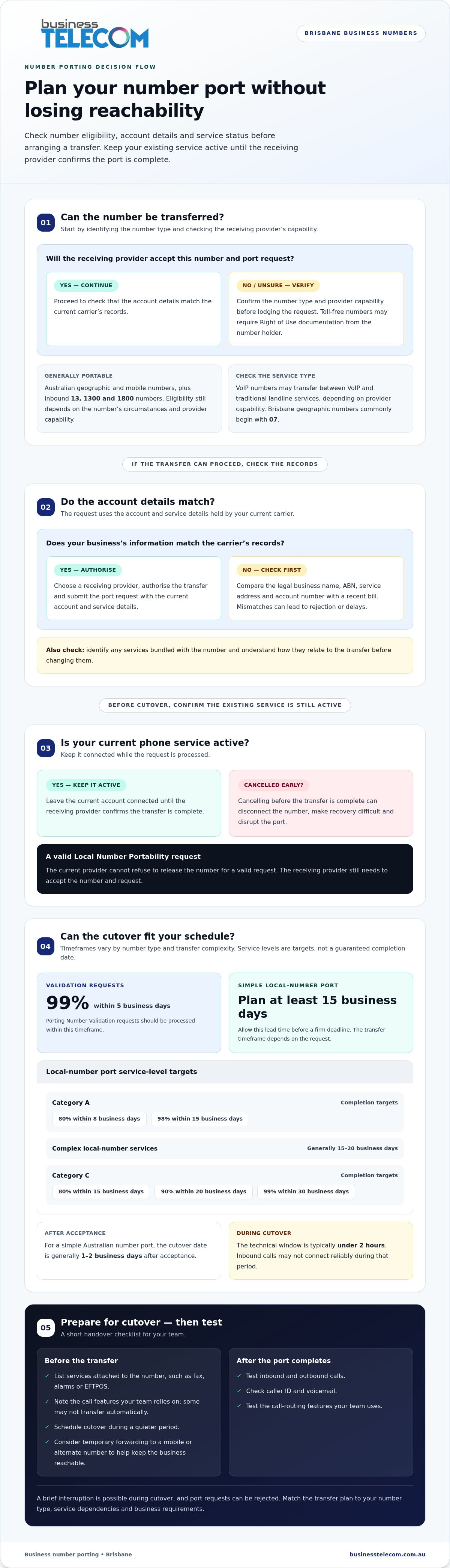
Yes. Your business can keep operating while a number port is arranged, although calls may be briefly affected during cutover. For business phone number porting in Brisbane, local numbers beginning with 07 are among the Australian geographic numbers commonly ported.
Timeframes depend on whether the request covers a simple local number or a more complex service. In Australia, 99% of Porting Number Validation requests should be processed within 5 business days. For Category A local-number ports, service levels target 80% completion within 8 business days and 98% within 15 business days. Complex local-number services generally need 15 to 20 business days. Category C targets are 80% within 15 business days, 90% within 20 business days and 99% within 30 business days. Start a simple local-number port at least 15 business days before a firm deadline.
When comparing Brisbane providers, ask which number types they accept, how they manage call quality, what support channels they offer and what their contract terms include. Check that the service can handle your expected call volume and internet connection. Compare contract length, included features and exit terms before deciding.
Australian carriers and VoIP providers may support number transfers, including transfers between landline and VoIP services. The receiving provider will need to confirm whether it can proceed with the request. However, for a valid Local Number Portability request, the current provider cannot refuse to release the number.
To port a number, choose a receiving provider, authorise the transfer and submit a request using the account and service details held by your current carrier. Keep the number active while the request is processed, then follow the receiving provider’s instructions for the cutover.
Local Number Portability lets customers retain eligible numbers when changing providers in Australia. Under the Telecommunications Numbering Plan 2025, carriers and carriage service providers cannot place unreasonable barriers on valid porting requests. The receiving provider still needs to accept the number and request.
Planning business phone number porting in Brisbane means matching the transfer to your number type and business requirements. A single 07 number may follow a different path from a number range or complex service, so allow time to coordinate the change with staff and customers.
Will my phone service be interrupted during the porting process?
Keep your existing service active until the receiving provider confirms the port is complete. A brief interruption may occur during cutover, so plan for calls to be affected.
Keeping Existing Services Active
Keeping the service active means leaving your current account connected until the receiving provider confirms the transfer is complete. Cancelling early can disconnect the number, making recovery difficult and disrupting the port.
Before lodging a port request, confirm that your business is the registered number holder and that the account details match your current carrier’s records. Check the legal business name, ABN, service address and account number against a recent bill. Mismatched details can lead to rejection or delays. Keep bundled services connected until you understand how they relate to the number being transferred.
Cutover and Temporary Interruptions
Cutover is the point when the number’s call routing moves from the existing carrier to the receiving provider. For a simple Australian number port, the cutover date is generally 1-2 business days after acceptance. The technical cutover window is typically under 2 hours, and inbound calls may not connect reliably during that period.
A brief interruption is one possible risk. Requests can also be rejected, and some call features may not transfer automatically. Before the change, list services attached to the number, such as fax, alarms or EFTPOS, and note the features your team relies on. Schedule the cutover during a quieter period. Temporary forwarding to a mobile or alternate number can help keep your business reachable.
After the port completes, test inbound and outbound calls, caller ID, voicemail and any call-routing features your team uses. For a Brisbane business reviewing its communications setup, business phone system options can help frame the next decision.
Number eligibility and geographic area considerations
Australian businesses can often port geographic, VoIP, mobile and inbound numbers, but eligibility depends on number type and provider capability. For a Brisbane 07 number, review its call routing and intended coverage before submitting the port request.
Eligible Number Types
Eligible number types are phone numbers that can be transferred between providers while retaining the number. Australian local geographic numbers, mobile numbers and inbound 13, 1300 and 1800 numbers are generally portable, though the receiving provider’s capabilities matter.
VoIP numbers can also be ported, including between VoIP and traditional landline services, depending on provider capabilities. Toll-free number transfers may require Right of Use documentation from the number holder. Before starting, identify each number type and whether your business controls it. A mobile number, for example, follows a different service type from a Brisbane 07 geographic number.
Geographic Number Portability
Geographic number portability lets a business transfer an eligible local number while retaining its area code. Brisbane numbers commonly begin with 07, which identifies their geographic numbering area.
If your business moves interstate, don’t assume that keeping an 07 number means the number reflects your new location. The prefix remains part of the number, while call routing determines where incoming calls are directed. Confirm that the proposed routing suits your new operating arrangements and customer expectations before submitting the port request.
For Brisbane businesses, check that the receiving service can accept the specific 07 number and route calls as required. A number’s area code does not by itself describe the provider’s service coverage or where staff answer calls. If you use a mobile number for business, confirm it is active and registered to the correct account holder. A contract with your current provider may also continue to carry obligations after the number moves.
List every number you plan to transfer, including geographic, VoIP, mobile and inbound numbers. Match each one to its account holder and current service details. This helps you identify whether the request covers a single number or involves different number types, ranges or routing arrangements. The porting process depends on these details, not simply on your business being based in Brisbane.
Porting fixed, VoIP and mobile business numbers
The porting process depends on the number’s current service type and any connected infrastructure. For Brisbane businesses, identifying how calls are handled today helps set expectations for the transfer and cutover.
Porting Fixed Business Numbers
A fixed-number port transfers a landline number from its current carrier to another provider. Australian landline ports typically take 10-20 business days, while ISDN or SIP numbers typically take 5-10 business days.
Older infrastructure, carrier bundles and attached services can make a port more involved. Before submitting the request, list the numbers and services included in the arrangement. Fax lines, alarm monitoring or EFTPOS connected to a number can delay the move if they are overlooked. Confirm which services must keep working after cutover rather than assuming they will all transfer with the number.
Porting VoIP Business Numbers
A VoIP port transfers a number used for calls over an internet-based phone service. Australian business VoIP numbers typically take 1-5 business days to port, and a straightforward VoIP-to-VoIP transfer often completes within a few business days.
Timing depends on the number details and the receiving provider’s capabilities. A transfer between VoIP and traditional landline service may be possible, but the service type can affect the process. Prepare the new call setup before cutover, including where calls should ring and which team members need access. This gives staff a clear way to handle incoming calls once the number moves.
Mobile numbers follow a separate porting process. In Australia, 90% of mobile number ports are completed within 3 hours, and 99% within 2 business days. Keep the mobile service active until the transfer finishes, then test incoming calls, outgoing calls and caller ID. This helps your business confirm the actual service works as expected after the change.
Knowing whether you’re moving a landline, VoIP or mobile number helps you plan the right cutover. Review your business communications requirements as you prepare for a number change.
Business Telecom: Business Phone System
Business Telecom provides Business Phone Systems for Brisbane businesses reviewing their communications setup alongside a number transfer. If porting is part of a wider change, consider how staff will answer calls, whether desk phones still suit the team and how employees working away from the office need to make or receive calls.
Business Land Lines and Office Phone Systems can suit businesses focused on fixed-line or office calling. Before choosing a setup, note the number types involved, who needs to handle calls and which call flows your team relies on. These details help you choose a phone system based on your work, not just the number.
Contact Business Telecom to discuss your Brisbane business phone system requirements.
Plan the next stage of your business calling
A number change is also an opportunity to review callers’ experience. Consider which teams should answer different enquiries, who will manage call-handling decisions and how staff should respond when the usual contact person is unavailable. Agreeing on these responsibilities early can make the transition easier for employees and customers.
For business phone number porting in Brisbane, include the transfer in your wider communications plan. Assign an internal point of contact, prepare clear guidance for staff and decide when to update customer-facing materials. A shared plan helps your team keep business communications consistent as arrangements change.
Business Telecom can discuss a Business Phone System or other suitable phone arrangements for your requirements. Contact Business Telecom about your plans and take the next step with a clear view of what your team needs. A considered plan gives your business a practical starting point for moving forward.
Frequently Asked Questions
What Happens to Your Number if You Leave Without Porting?
If your number was disconnected by mistake, contact the provider that disconnected it and request its return. In Australia, a provider must reissue a number within one business day if it disconnected the number in error and the customer asks. This differs from voluntarily leaving a service, so act promptly if you believe the disconnection was incorrect.
Why Should You Port Your Number?
Porting can help you keep a number customers already use to reach your business while you change phone arrangements. This may be useful if the number appears in established referral processes, supplier records or business documents. Consider its ongoing role before deciding: transferring it may not make sense if your business plans to retire that contact channel.
Does Porting Take Longer When Moving Offices?
Moving premises can make a port more involved if the service address, routing or number arrangement also changes. Plan the office move and number transfer together: prepare the receiving phone service for the new premises and align the requested transfer with your relocation schedule. Updates to your billing contact or registered business details may also matter to the carrier.
Should I cancel my phone service before the port completes?
No. Wait until the receiving provider confirms the transfer, then review the old account before closing it. A bundled account may include other services your business still uses, and contract obligations may continue after the number moves. Check the final account arrangements to avoid unintentionally affecting a separate connection or outstanding commitment.
What Types of Numbers Can Be Ported?
For 13, 1300 and 1800 numbers, the transfer process differs from ordinary local-number porting because these numbers are assigned through the ACMA Smart Numbers database. A transfer also requires Right of Use documentation from the number holder. Gather that evidence alongside the relevant account details, particularly if the number is held by a different legal entity from the business using it.
What is Local Number Portability in Australia?
For a business, Local Number Portability concerns transferring an eligible number between providers, rather than automatically transferring every feature attached to it. The Australian number-porting Code requires the gaining provider to obtain the customer’s authority under section 4.1.2. This means the authorised business representative should understand which numbers are included and approve the request before it is lodged.